Studying Ultrafast Molecular Dynamics in Pump-Probe Experiments with Femtosecond Lasers
Andrew Rosenstein, Bowdoin College, Physics Major
Mentored by Dr. Daniel Rolles and Dr. Artem Rudenko
Short-pulsed lasers are an important tool in studying molecular isomerization, a process which operates on extremely short timescales. Such laser pulses are used in the James R. Macdonald laboratory to conduct pump-probe experiments, in which two ‘pump’ and ’probe’ laser pulses excite and then explode molecules. This explosion allows for Coulomb Explosion Imaging (CEI), yielding time-of-flight (TOF) spectra & positional data in the KAMP chamber containing the target molecules. The momenta, kinetic energies and emission angles of the corresponding ions can then be calculated from this data.
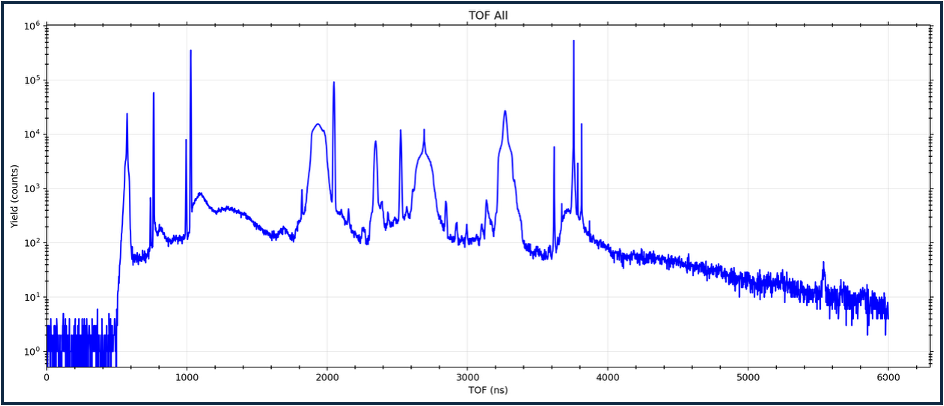
Fig. 1.TOF spectrum for SO2 molecule fragmented by FLAME laser pulse.
The FLAME laser in the James R. Macdonald laboratory employs a COHERENT Legend Elite Duo, a Ti-Sapphire laser system capable of creating ~25 fs pulses at 3 kHz. Working with some molecules requires pulses of 10 fs or less. The goal of my project was to modify the pulses created by the FLAME laser to generate these ultrafast laser pulses. <p> We were able to compress the pulses by increasing the bandwidth of the laser. To do this, The beam was sent through a hollow-core fiber held in a chamber filled with argon gas, which induced nonlinear interactions that were able to broaden the wavelength spectrum.
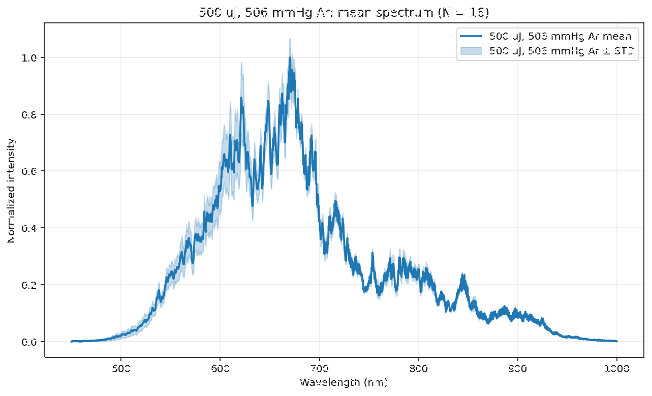
Fig. 2.Wavelength spectrum of FLAME laser after passing through hollow-core fiber.
The laser beam then passes through several other optical components. Banks of chirped mirrors are used to compensate for dispersive effects caused by the beam interacting with air. These mirrors have several layers with different reflective properties and serve to preserve the short pulses as the beam travels to the KAMP chamber, where pump-probe experiments are conducted.
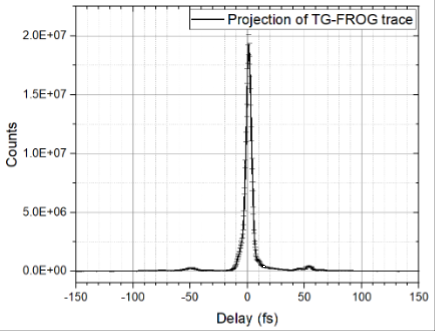
Fig. 3. Laser pulse duration as measured by TG-FROG.
Autocorrelation data shows the change in pulse duration as a result of the hollow-core fiber, as seen in figures 4 and 5.
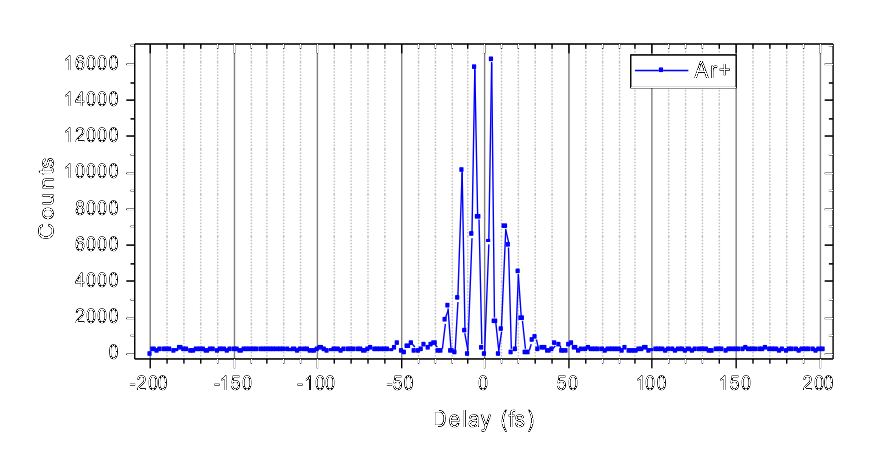
Fig. 4. FLAME pulses before the hollow-core fiber.
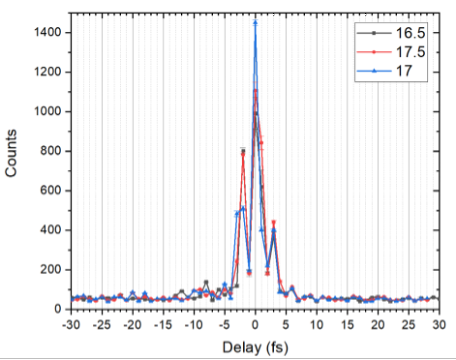
Fig. 5. FLAME pulses after the hollow-core fiber at various settings, showing consistently short pulses.
Before entering KAMP, the laser passes through a beam splitter, which sends the pulse down two separate paths of differing lengths, creating separate ‘pump’ and ‘probe’ laser pulses. The path length can be precisely adjusted to change the time between the two pulses. Experimental results have thus far shown that with these shorter pulses, FLAME is able to resolve D2+ vibrations with ~23 fs period. These pulses will continue to be used in the future to run further pump-probe experiments on other, more complex molecules.
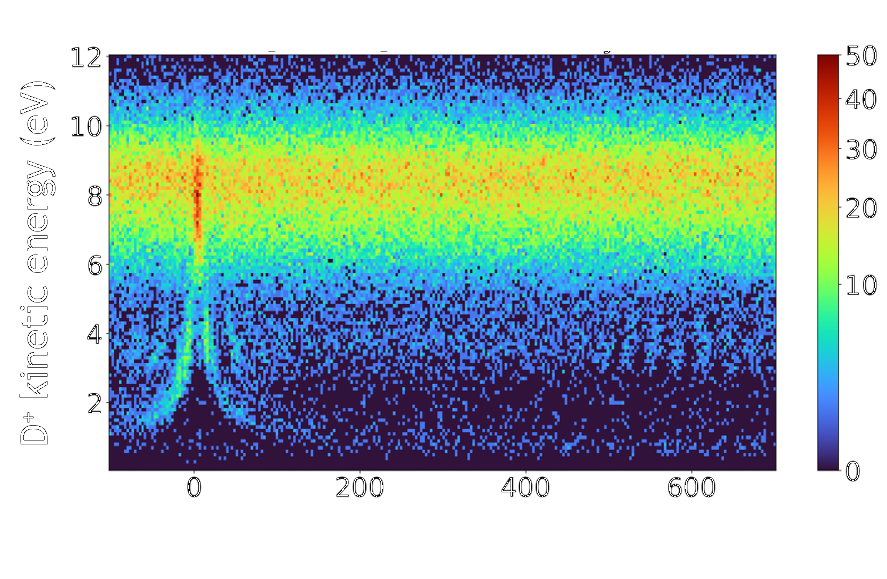
Fig. 6. Counts and kinetic energies of fragmented D2+ ions.
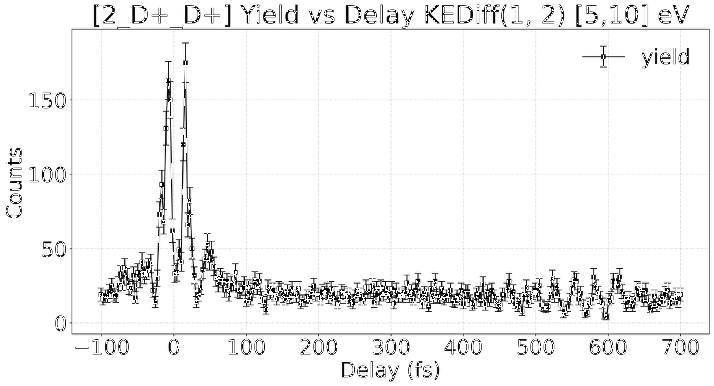
Fig. 7. Ion count vs delay, showing vibrations of D2+ with ~23 fs period.
Acknowledgments