Searches for Double Charged Higgs Production at the Large Hadron Collider
Andrew Klassen Kansas State University, Physics Major
Mentored by Dr. Andrew Ivanov
The Doubly-Charged Higgs Boson (DCH) is a theorized particle that would expand the Standard Model upon being discovered. These particles would be created in pairs from extremely high energy (>1TeV) proton collisions. Since these particles are very heavy, they have many different decay modes, but this research is mostly concerned with their leptonic decay. In this type of decay, each DCH decays into two leptons: an electron, muon, and/or tau. The two leptons that come from the same DCH are known as a leg, and both leptons on a leg have the same-sign (SS) charge. Additionally, the only restriction on leptonic decay is the DCH cannot decay directly into neutrinos, meaning any combination of electrons, muons, or tau is possible.
Tau particles represent a significant challenge in DCH studies. Tau decay once more, emitting a neutrino (sometimes more than one neutrino is emitted from a tau, but they are functionally the same as a single neutrino emitted from that tau) and a hadron or lepton. The study of DCH particles observes the emitted leptons and hadrons in order to estimate the mass of the original DCH pair. Neutrinos make these estimations tricky, as they are not detected by the Large Hadron Collider (LHC) and carry some of the energy that needs to be accounted for.
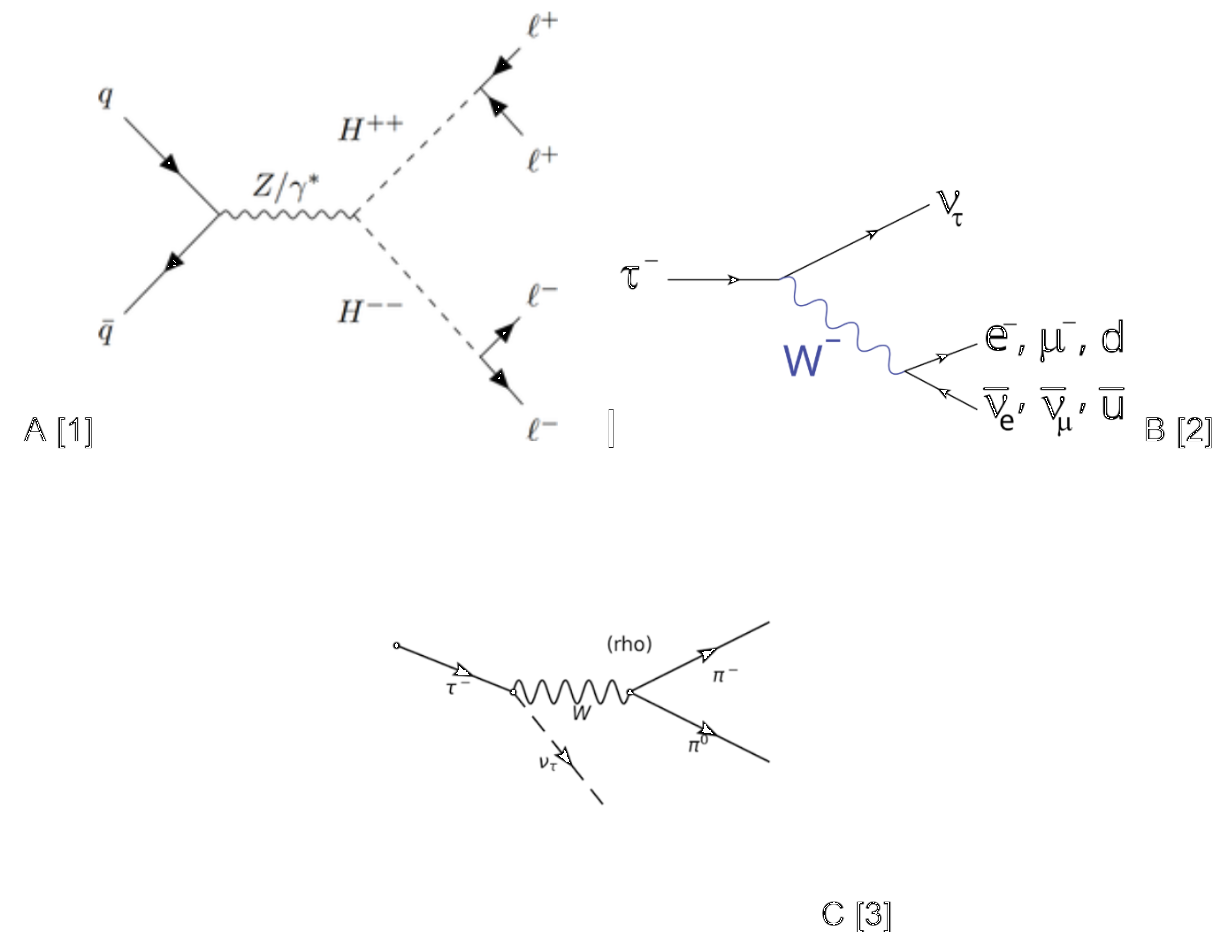
Fig. 1. Feynman diagrams representing A) Leptonic decay of a DCH, B) Leptonic decay of a tau, and C) Hadronic decay of a tau.
When a DCH emits a tau, most of the DCH mass is converted to kinetic energy. When the tau decays again, the extremely high momentum given by the DCH is passed to the neutrino and the hadron or lepton. As a result, the change in momentum due to the tau’s decay is inconsequential compared to the energy given by the DCH decay, meaning the neutrino is mostly collinear to the lepton or hadron. Collinearity means that the neutrino can be represented by a simple coefficient (α), simplifying the mass calculations and momentum representation, as shown in Figure 2.

Fig. 2a. Representation of neutrinos via a positive constant (α).

Fig. 2b. Mass calculation using α's.
To find an initial value for α’s, the amount of energy missing from a system must be determined. When neutrinos are present, the net transverse momentum usually sums up to a nonzero value. This value is known as Missing Transverse Energy, and it is attributed to neutrinos. MET is a two-component vector, which can be employed to calculate initial values for one or two α’s. Figure 3 shows how initial values for α are calculated in a two-neutrino system.
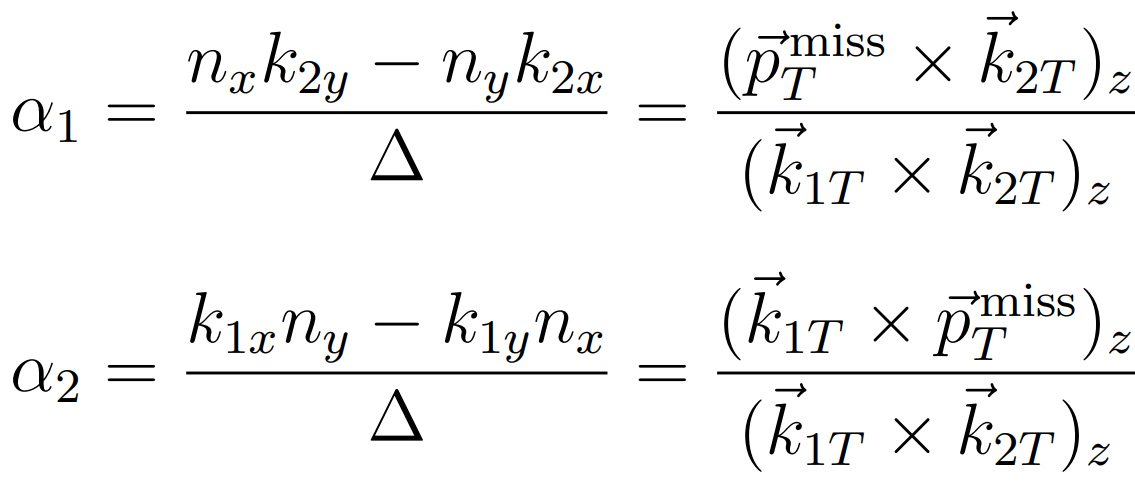
Fig. 3. Initial α estimation for a two-neutrino system.
Estimations become necessary when uncertainties are considered. Direct calculations of DCH mass from initial α’s will result in two different masses for each DCH in a pair, which is a theoretical impossibility. Thus, an estimation that considers both expected α values and a common DCH must be used. For these studies, estimations are completed via a chi-squared (Χ2) minimization. Χ2 represents a goodness-of-fit, meaning that it acts as a confidence for how well an approximated α describes the system while remaining close to the initial α values.

Fig. 4. General form for Χ2 calculation in regard to DCH mass estimations. Note: α = {α1, α2}T, W = cov(α), λ = mass-variance constraint
For systems with two or fewer neutrinos, the MET gives enough information to perform the calculations shown in Figures 3 and 4. However, the emission of three or four neutrinos results in an undetermined system. MET no longer provides enough constraints to exactly determine initial values for three α’s and perform a Χ2 calculation.
My research group theorized one possible assumption that generates an additional constraint, meaning three-neutrino estimations were possible. In fewer-neutrino estimations, the z-component of the momentum is ignored. However, by shifting to the center-of-mass (COM) frame of the daughter particle system, the net z-momentum is zero by definition. We then make the assumption that the bare lepton (the lepton not emitted with a neutrino) has a z-momentum of zero. This constraint allows the third neutrino (typically assigned to the leg with only one neutrino) to be described by the other two neutrinos (typically assigned to the same leg). There were two different ways to implement this new constraint, and my project over the summer was to implement these two methods.

Fig. 5. My research group’s additional assumption.
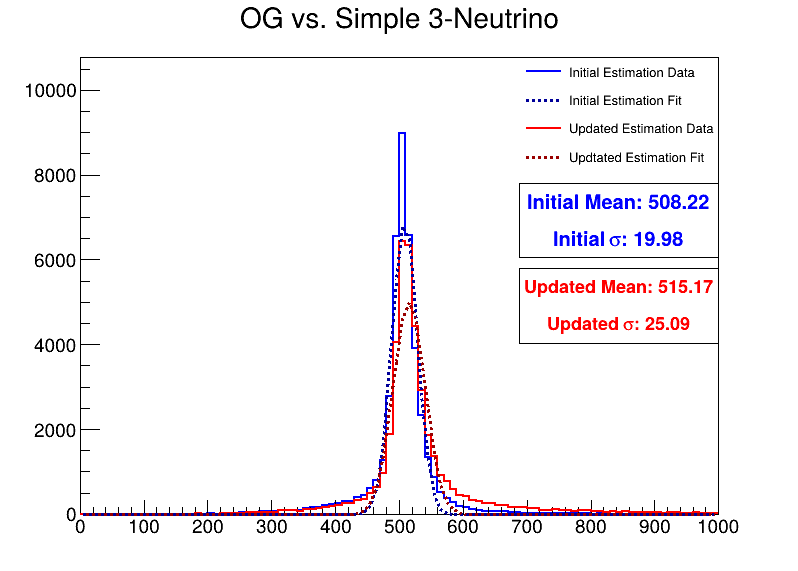
The first method I implemented was a simple three-neutrino estimation. It utilizes both two-neutrino estimation methods: one for a system with two-neutrinos on one leg, and one for a system with a neutrino on each leg. The simple three-neutrino estimation calculates the initial guess for the third α, then completes both two-neutrino estimations. If both yield estimations that are within a threshold, then Χ2 value is lowered by an arbitrary amount (Χ2 was lowered by 5% in the case of Figure 3) to indicate that the system is better described as a three neutrino system.
 |
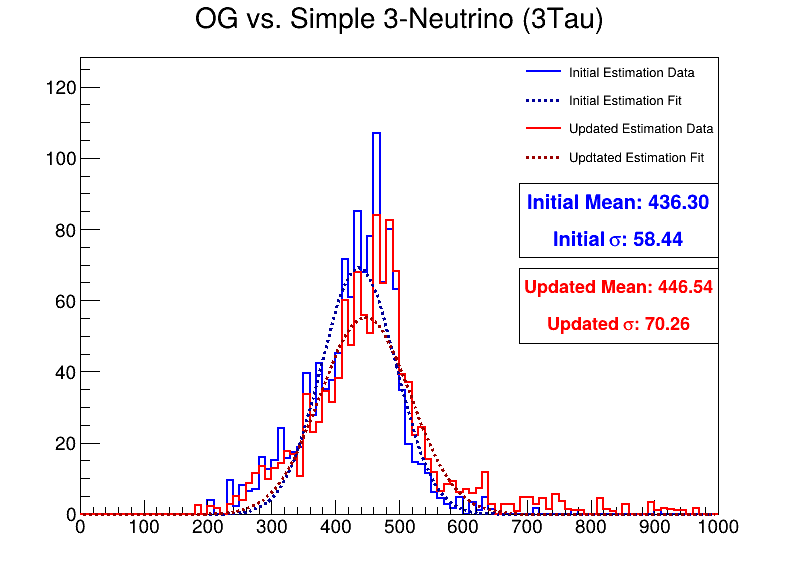 |
Fig 6. DCH mass comparison. Left) Mass estimation of first DCH. Right) Mass estimation of first DCH from events with 3 tau particles present.
Figure 3 shows the simple three-neutrino estimation is not flawless. The two-neutrino estimation fails to account for the third neutrino in its estimation. This flaw results in a larger deviation in the mass estimations, and indicates the need for an improved estimation.
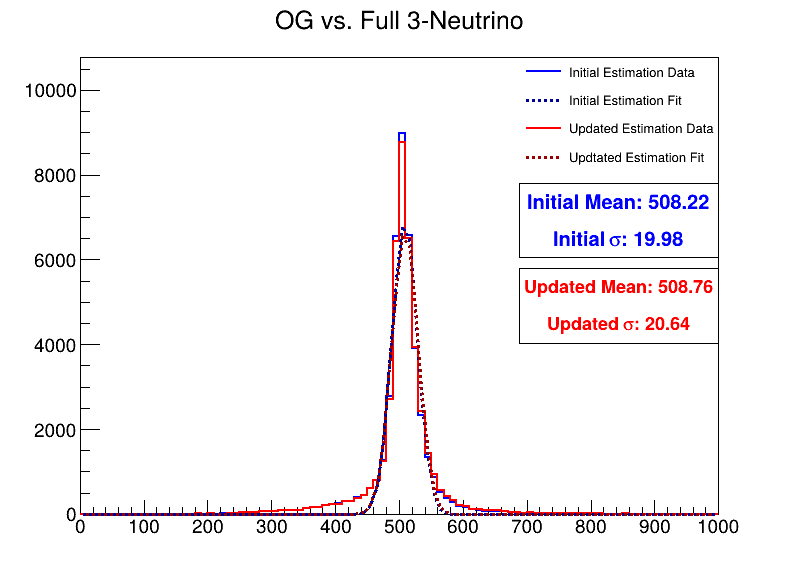
The other method was a full three-neutrino estimation, which is a more fleshed out approach. It functions similarly to the paired two-neutrino estimation by utilizing a Gauss-Newtonian algorithm to generate better values of α, which is an iterative process.
 |
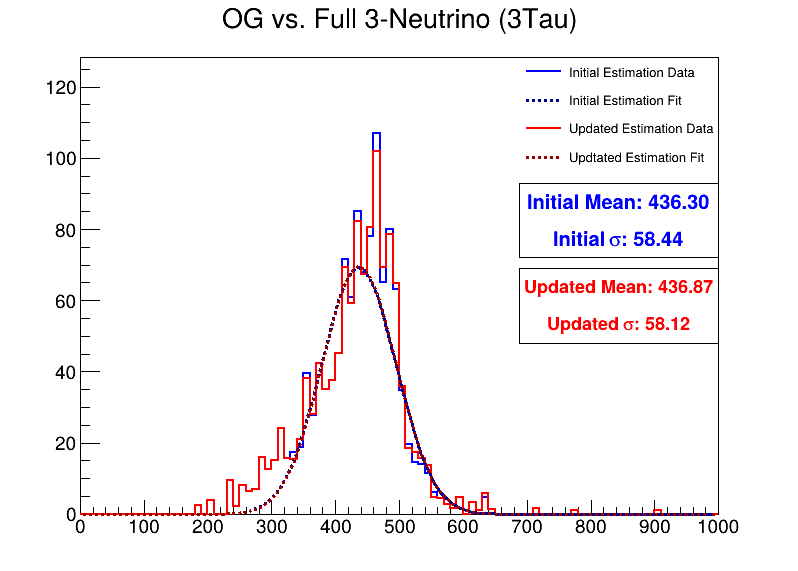 |
Fig 7. DCH mass comparison. Left) Mass estimation of first DCH. Right) Mass estimation of first DCH from events with 3 tau particles present.
This estimation tends to yield better results than the simple three-neutrino estimation, but as compared to the results without either three-neutrino method, the deviation is higher. A few of the estimations for certain flavor combinations do show improvements, such as the right plot of Figure 4, but the overall increase in deviation indicates the estimation is faulty.
The inferior plots created by the updated program could be due to a few reasons: the additional constraint on the z-momentum generalizes too much or there are bugs or issues in the code’s workings. In the future, I aim to take a deeper dive into the individual details of these estimations in order to ensure that the three-neutrino estimations are functioning as intended.
References
[1] ATLAS Collaboration, "Search for doubly and singly charged Higgs bosons decaying into same-sign leptons in pp collisions at sqrt{s} = 13 TeV with the ATLAS detector," CERN Document Server, CERN-EP-2022-083, May 2022. Available: https://cds.cern.ch/record/2808604
[2] JabberWok and Time3000, "Feynman diagram of decay of tau lepton," Wikimedia Commons, Feb. 29, 2008. [Online]. Available: https://commons.wikimedia.org/wiki/File:Feynman_diagram_of_decay_of_tau_lepton.svg

[3] M. Yaari, U. Barron, L. Pascual Dominguez, and R. Gyres, "Feynman diagrams of the most frequent hadronic decays of the tau lepton," in Trees versus Neural Networks for enhancing tau lepton real-time selection in proton-proton collisions, Jun. 2024. [Online]. Available: https://www.researchgate.net/figure/Feynman-diagrams-of-the-most-frequent-hadronic-decays-of-the-t-lepton-The-probability-of_fig1_381253407
Acknowledgments
I want to thank my mentor, Dr. Andrew Ivanov, for creating this opportunity and guiding my work. I would also like to thank the Kim Coy, Dr. Bret Flanders, Dr. Cosmin Blaga, and the rest of the Physics Department for running this REU and supporting us through the summer, as well as the NSF for their funding. I also want to thank my fellow REU members for their support and friendship.
This material is based upon work supported by the National Science Foundation under Grant No. 2548403. Any opinions, findings, and conclusions or recommendations expressed in this material are those of the author(s) and do not necessarily reflect the views of the National Science Foundation.