Generating a Bright Squeezed Vacuum at 800 nm from a 800nm Femtosecond Laser
Samuel Boysen, Reed College, Physics Major
Mentored by Dr. Vinod Kumarappan
A bright squeezed vacuum (BSV) is a macroscopic quantum state of light with the unusual property of having an average electric field of zero [1]. It can be produced using spontaneous parametric downconversion (SPDC) in a nonlinear crystal which amplifies vacuum fluctuations when they are in phase with the pump [2]. BSVs have been found to be more efficient than conventional coherent light for certain kinds of nonlinear optical processes [3]. The main goal of the project is to produce a BSV at 800 nm with sufficient intensity to be useful in pump-probe experiments using a ~30 femtosecond 800nm Ti:Sapphire laser (FLAME). Towards that end, a literature search was conducted to learn how to produce a BSV and the results of that search were applied to build a setup that will produce a BSV once fully optimized.
The setup used is shown in Fig. 1. It is based off of the one used by [1], but is modified due to the particularities of the equipment available. Starting on the right side of the figure, the laser enters the experiment and is collimated using a telescope constructed from two lenses. From there it is passed through a half wave plate so that the 400nm light produced by second harmonic generation (SHG) in the following BBO crystal has the right polarization. The correct polarization is necessary for the 400nm light to be minimally reflected when it is passed through the prisms at the Brewster angle in the upcoming prism compressor. The prism compressor is used to separate the 400nm light from the 800nm light leftover from SHG and shorten the laser's pulse duration. The purified 400nm light is then sent through two 0.2mm BBO crystals for SPDC into a BSV. Two crystals are used to increase conversion efficiency, filter out unwanted spatial modes, and correct for walk-off [1]. The length of the crystals was chosen in an attempt to minimize the temporal walk-off experienced by the pulses and the distance between the crystals was chosen to provide constructive interference. After proceeding through the crystals the light encounters separators which pull out the remaining 400nm light before the remaining light is focused into a spectrometer using a lens. Eventually, a chopper will be placed in front of the spectrometer so that single shot spectra of the BSV pulses can be analyzed. Those spectrums will be used to calculate the zero delay second order correlation function at each wavelength, which can be used to confirm that a BSV was actually produced and provide information about its properties [1].
Figure 2 shows spectrometer data, which indicates that little to no BSV is being produced. The small bump at 800nm was determined to be from light scattered by the first prism as it does not disappear when the beam going to the SPDC crystals is blocked, but it does disappear when the beam to the first prism is blocked. The data does indicate that the 400nm light is being effectively separated from the 800nm light leftover from the SHG process as there is no significant signal at 800nm. The 800nm portion of the spectrum shows no response to adjustments in the distance between the SPDC crystals and the orientation of the crystals. Those factors affect how much BSV is produced by changing how well the crystals are phased matched [4]. Thus, the lack of any response as those parameters are adjusted over a wide range indicates that the SPDC process in the BBO crystals is currently too inefficient to produce a measurable signal.
SPDC efficiency could potentially be improved by increasing the pulse intensity or increasing the length of the crystals themselves. Increasing the peak pulse intensity can be done by shortening the pulse duration [4] or increasing the pump power. Although the prism compressor was already considerably long to separate the SHG wavelengths, further lengthening it could shorten the pulses further. Time ran short before that option was able to be exhausted. Lengthening the SPDC crystals would give the pulse more time to interact with the crystal potentially increasing efficiency, but it would also reduce overlap between the pump and BSV pulses due to walk-off decreasing efficiency.
Considerable progress was made towards producing a BSV for pump-probe experiments using a femtosecond 800nm laser. A literature search on how to produce a BSV was conducted and the results were used to assemble a setup for producing a BSV from scratch. While time constraints prevented the full optimization of the setup needed to produce a measurable signal, that work will be continued by graduate students after the end of the REU program.
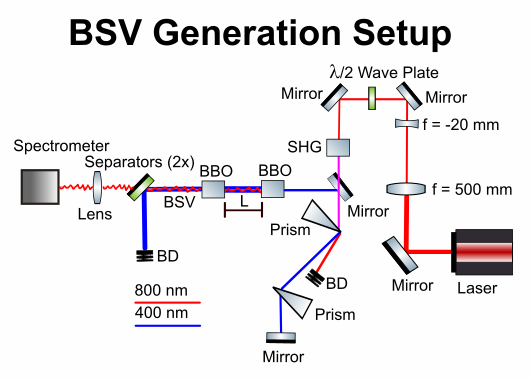
Fig. 1. Set-up for producing a BSV.
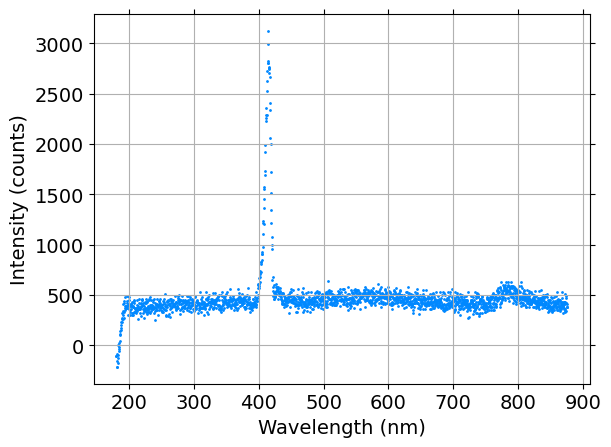
Fig. 2. Plot of counts versus wavelength recorded by a FLAME S spectrometer. The data is not single shot resolved. The large spike at 400nm is from the portion of the pump that makes it past the two separators. The smaller bump at 800nm is not a genuine signal, but was determined to be from scattering inside one of the prisms.
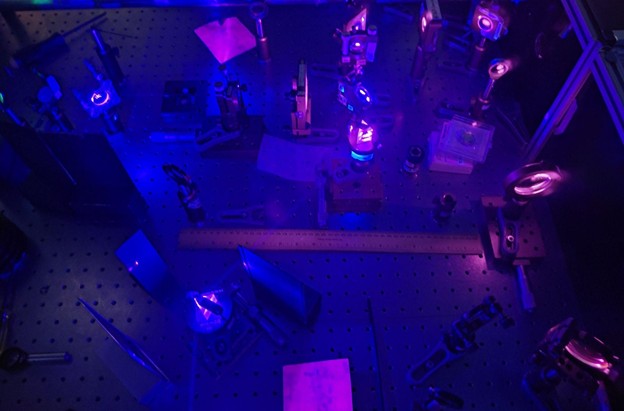
Fig. 3. Picture of the setup with the lights off. While it may look cool, the prism’s glow is not particularly helpful when aiming for a clean spectrum (see Fig. 2). Between the prisms, the beam path is made visible in the air.
References
[1] Kern, Y., Nisim, I., Birk, M., Rasputnyi, A., Behar, D., Chen, Z., Kaminer, I., Sidorenko, P., Cohen, O., & Kruger, M. (2026). Single-shot pulse retrieval of femtosecond bright squeezed vacuum. Optica, 13(3), 395–399.
[2] Fox, M. (2006). Quantum optics: An introduction (Oxford Master Series in Physics, Vol. 6). Oxford University Press.
[3] Jiang, Z., Pan, S., Chen, J., Zhu, M., Zhao, C., Wang, Y., Zhang, R., Lu, J., Han, L., Xiong, S., Wu, D., Li, W., Jiang, S., Ni, H., & Wu, J. (2026). Nonlinear atomic tunneling boosted by bright squeezed vacuum. Nature.
[4] New, G. (2011). Introduction to nonlinear optics. Cambridge University Press.
Acknowledgments
I would like to thank my advisor Vinod Kumarappan for facilitating this opportunity and teaching me many things, his graduate students Wyatt Jones and Kamrunnahar Kali who helped me with alignment among other things, and my fellow REU student Sophia Wismar who also worked with Dr. Kumarappan. I would also like to thank the program directors Dr. Bret Flanders and Dr. Cosmin Blaga, Kim Coy, the JRM staff, and my fellow REU students.
I greatly appreciate and acknowledge the funding provided by the NSF and the DOE for this program.
This material is based upon work supported by the National Science Foundation under Grant No. 2548403. Participants from K-State were supported by the US Department of Energy under Grant No. DE-FG02-86ER13491. Any opinions, findings, and conclusions or recommendations expressed in this material are those of the author(s) and do not necessarily reflect the views of the National Science Foundation or the Department of Energy.