Graphene, Grit, and the 9th Symphony
A Profile of Chris Sorensen
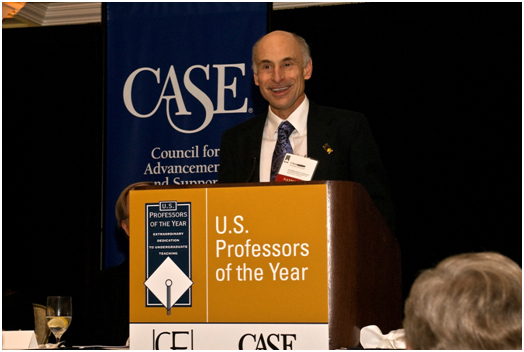
For Distinguished Professor Emeritus Chris Sorensen, a 45-year career traces back to a single, scary, adrenaline-fueled afternoon. Tasked with an Engineering Physics recitation as his first teaching assignment here at K-State, he "prepared his ass off" only to find an unexpected thrill once the session began. "I didn't realize how much fun I was having," he recalls. "I walked out thinking, 'Was that as good for you as it was for me?'" He was hooked on teaching from that moment on.
When asked about what technological shift he thought had changed physics education the most throughout his lifetime, despite witnessing the shift from chalkboards to AI-enhanced physics on an iPad, Sorensen remains a critic of PowerPoint. He views it as a "double-edged sword" that can sever the bond between teacher and student. For Sorensen, a great lecture is a "stream of consciousness" fueled by intense preparation for intimacy with your students. "You can’t connect when you’re just pointing at a screen," he says. "It’s got to be a part of you—a real, living thing."
When asked to pinpoint a single "Eureka" moment in his research, Sorensen’s thoughts immediately turned toward his students. He admits that for every breakthrough, there were countless days of frustration. “Numerous times I’d go home and tell my wife, Georgia, that the laser broke, the idea didn’t work, or a grant was turned down,” he recalls. But even on the hardest days in the lab, there was a silver lining: “I’d tell her, ‘But I had a great time teaching today.’” For Sorensen, the classroom was more than a required part of the job; it was the steady joy that "bailed him out" from the inherent disappointments of R-1 research.
Bear in mind that Sorensen’s research was defined by a similar passion. While "blowing sh*t up" in a lab chamber to study fractal structures one day, he opened the lid to find what he called "the darkest, blackest angel food cake"—a discovery of the aerosol gelation process. In 2006, serendipity struck when he realized that black cake was actually graphene. While others chased fads, Sorensen quietly perfected the method, eventually securing a patent that is now drawing global attention.
Sorensen has always viewed good physics as a creative act, similar to what goes into poetry and classical music. "I believe the best thing any human can do is be creative with their mind," he says. "If I could create science as beautiful as Beethoven’s Ninth Symphony, what a marvelous thing that would be." This pursuit of beauty guided him through both his scientific efforts and teaching at every level, from "The Physical World" to advanced seminars. His goal was always to "connect across the divide," making the mathematical beauty of the universe accessible to everyone.
When asked about a particular student that stands out to him over his career, he points to Eli Jaggard Gilbertson, an arts-focused student who made a 180-degree turn into physics and earned an MS in 2008 under his direction. Sorensen told that she was ‘tough’ in the manner that setbacks would not set her back. He acted as her "cornerman," cheering her on through struggles that would have prompted others to quit. Today, she is a scientist at Los Alamos National Laboratory—a testament to Sorensen’s belief that grit matters more than natural talent.
While many view emeritus status as a time to rest, Chris Sorensen has traded the lecture hall for the cutting edge of global innovation. Now serving as the Vice President of R&D for HydroGraph, the business based on his graphene patents, his mission has shifted from expanding pure science to creating new methods. "I’ve become an inventor," he says, with ten patents and another ten pending. At 78, he remains as driven as ever: "The brain is still working and the ideas are still coming. My biggest frustration is just not having all the lab equipment I need!"
HydroGraph is currently at the center of the graphene revolution, but that journey is taking a new geographical turn. Because Sorensen’s patented "explosion synthesis process" relies on acetylene as a feedstock, the company is relocating its operations from Manhattan to Austin, Texas, where the resource is more accessible and cost-effective. While the roots of the discovery are at K-State, the future of the technology will be cultivated in partnership with UT Austin.
"We’re not in Kansas anymore, Toto," Sorensen jokes. Despite the move, the global impact of the work remains undeniable. HydroGraph continues to maintain a world-class presence at the Graphene Engineering Innovation Centre (GEIC) in Manchester, England. As a "prodigal son" of the GEIC, Sorensen is taking K-State-born technology to the global stage, proving that the best science doesn't just stay in the lab—it changes the world.
As for his legacy in Cardwell Hall? He hopes to be remembered as someone who saw teaching and engaging the public as foundational for humanity. "And yeah," he adds with a smile, "I did some pretty good science too."