Discovery in Action
A Look Inside Our Research Groups
If there is a single theme that captures the spirit of Cardwell Hall over the past year, it is momentum. Whether tracing the pathways of tiny biological biological motors, capturing the quickest flashes of light ever created by humanity, or tracking data from the world's most powerful particle colliders, K-State Physics continues to cement its reputation as a world-class hub for breakthrough research.
Our department thrives on a unique blend of foundational discovery and real-world application. This year, that balance was recognized at the highest levels, highlighted by the successful renewal of major federal funding grants and prestigious national accolades for our faculty, postdocs, and students alike.
Behind every grant won, paper published, and patent awarded is a commitment to mentorship. From giving undergraduate students the chance to become co-inventors on patented technology to training the next generation of PhDs and educators, our pipeline of talent remains incredibly robust. Even as we bid a fond farewell to long-tenured icons entering retirement, our facilities are being revitalized and a dynamic new wave of faculty and students are stepping up to lead.
As you read through this year's updates from our individual research groups, we hope you share in our pride. K-State Physics isn't just keeping pace with the frontiers of science—our faculty, students, and alumni are actively defining them.
Atomic, Molecular & Optical Physics
It has been a season of remarkable achievements and fresh starts in the James R. Macdonald Laboratory (JRML). We are thrilled to announce the successful renewal of our Department of Energy (DOE) funding grant, ensuring the continued momentum of our world-class research initiatives.
Our team of Atomic, Molecular, and Optical (AMO) experimentalists—Itzik Ben Itzhak, Cosmin Blaga, Meng Han, Vinod Kumarappan, Daniel Rolles, and Artem Rudenko—continues to push boundaries using both our in-house suite of ultrafast lasers and cutting-edge instruments at national and international facilities. An enduring strength of our program remains the close collaboration between these experimentalists and our theory group: Loren Greenman, Chii-Dong Lin, and Uwe Thumm. University Distinguished Professor Emeritus Lin formally retired in August 2025, though it has not slowed his scientific output in the slightest!
Meng Han achieved a rare and highly prestigious "double" by receiving both NSF and DOE CAREER awards. Additionally, Dr. Han was named the inaugural recipient of the Early Career Achievement Award in AMO Physics, made possible by the generosity of Chii-Dong Lin, Shu-Mei Lin, and other friends of K-State Physics. On the research front, Han’s Atto-Pharos lab has successfully produced some of the shortest light pulses ever generated on Earth.
Cosmin Blaga is continuing a collaborative project originally started by adjunct faculty member and current NIST scientist Brian Washburn alongside K-State Agronomy’s Eduardo Santos. The project utilizes fiber lasers to measure methane concentrations in grazed pastures—proving that we study all kinds of "field theory" at K-State!
Daniel Rolles and new research assistant professor Huynh Lam are pushing AMO physics into the frontiers of artificial intelligence and machine learning, supported in part by the K-State GRIPex initiative. Meanwhile, PhD student Zane Phelps was selected for the prestigious DOE Office of Science Graduate Student Research (SCGSR) program, allowing him to advance his doctoral research directly at a national laboratory. Rolles successfully mentored Anbu Venkatachalam who completed his PhD in the spring semester.
The JRML technical staff have been hard at work revitalizing our facilities, executing a deep clean and repainting the lab spaces to keep our research environment in top shape.
We extend our deepest gratitude to Distinguished Professor Emeritus Brett Esry and Vince Needham and wish them the absolute best in their well-deserved retirements after years of dedicated service to the department.
Physics Education Research
The K-State Physics Education Research (K-SUPER) group was thrilled to welcome Qiaoyi (Joey) Liu as its newest member. Joey is already establishing collaborative partnerships with faculty across both the Physics and Mathematics departments here at K-State. Beyond our campus, he is building strong research ties and applying for funding with other institutions, including K-State alumna Jackie Chini ('07), who is now at The Ohio State University. In addition, a proposal he submitted in collaboration with math professor Andy Bennett, has been awarded a grant from the One K-State Fund. This project focuses on embedding modern computational methods into high-enrollment STEM courses — a vital step in preparing students for an increasingly tech-driven workforce.
Associate Professor J.T. Laverty has had a productive year mentoring the next generation of physicists. Following the successful graduation of Bill Bridges in summer 2025, J.T. is now working closely with current PhD students Yohanes Dua and Parker Poulos as they advance their research within the PER group.
Graduate research assistant Parker Poulos was the recipient of the 2025 Graduate Student Council Award for Graduate Student Teaching Excellence.
Emeritus Professor Dean Zollman remains a deeply active and valued member of our research community. In addition to contributing to our weekly PER seminars, Dean continues to share his expertise on the global stage. This past year, he presented at the GIREP-EPEC Conference in the Netherlands and traveled to the Indian Institute of Technology in January to speak at the International Conference on Physics Education.
High Energy Physics
The High Energy Physics group concludes another landmark year of collaborations at CERN, Fermilab, and DUNE, with our members taking on pivotal roles in the global physics community.
Keti Kaadze continues her vital work at CERN as the Project Manager of the CMS Hadron Calorimeter (HCAL). In this role, she leads a diverse international team in developing, maintaining, and upgrading a core sub-detector of the CMS apparatus—work that integrates high-level engineering and global collaboration to enable world-leading physics results.
Andrew Ivanov continues to serve as the NSF project manager overseeing the development of electronics for the high-luminosity pixel detector upgrade for the CMS experiment at the Large Hadron Collider. In this crucial role, he manages the collaborative work of several U.S. institutions. Locally, Andrew also performs substantial, hands-on instrumentation work right here at K-State with the KSU Electronics Design Laboratory.
Glenn Horton-Smith is deeply involved with the Mu2e project at Fermilab. He successfully mentored Lauren Carroll, who completed her MS last summer, and welcomed Jennifer Tyler to his list of graduated students as she delivered a successful PhD defense in April. Meanwhile, Tim Bolton continues his impactful work with the DUNE collaboration.
The group is especially proud of the national recognition earned by our researchers. Postdoctoral Fellow Dennis Roy was honored for his exceptional leadership in HCAL Operations and significant technical contributions to the detector. Additionally, Graduate Research Assistant Braden Allmond was recognized for his work enhancing the High-Level Trigger (HLT) performance of tau triggers.
Our mentorship pipeline remains strong. Tim Bolton’s recent PhD advisee, Adil Hussain (’25), has transitioned to a postdoctoral position at the South Dakota School of Mines.
Cosmology
Bharat Ratra continues to share his wisdom in the K-State classrooms and on the national stage. From working with undergraduate students in General Physics classrooms to hosting QuarkNet workshops with high school teachers on the K-State campus, to delivering invited lectures about dark energy on the international stage, he remains in popular demand.
He recently added another distinction to his list of accolades, being named a 5 Sigma Physicist Honoree. This honor recognizes APS members who have demonstrated substantial advocacy activity and continued communication with the APS Government Affairs and Public Affairs teams.
In addition to his extensive scientific work with the DESI, Euclid, and Nancy Grace Roman telescopes, Lado Samushia has been partnering with K-State Salina to develop a suite of new online courses in astrodynamics. These courses are specifically tailored for the professional development of mid-career aerospace professionals.
Biological, Soft & Condensed Matter Physics
Matt Berg and co-inventor Jesse Laning were recently awarded a patent for their groundbreaking work, "Methods and Apparatus for Contactless Orthographic Imaging of Aerosol Particles." Remarkably, Jesse co-invented this technology as an undergraduate intern in Matt's lab; he has since earned his MS from UCF and now works as a Systems Engineer at MIT Lincoln Laboratory. Adding to the group's accolades, Berg was named the inaugural recipient of the K-State Physics Condensed Matter Achievement Award—established by University Distinguished Professor Emeritus Christopher Sorensen to highlight innovation in the field.
Buddho Chakrabarti recently received a new proposal award to explore the physics of "active matter"—living or self-propelled systems that can move on their own energy. From the way bacteria swarm to how cells organize inside our bodies, these systems create complex, coordinated motions within fluids. Chakrabarti’s group uses advanced physics and math to model these behaviors. Understanding how these tiny biological "engines" interact with their environments is a crucial step toward designing future biomedical technologies and advanced smart materials.
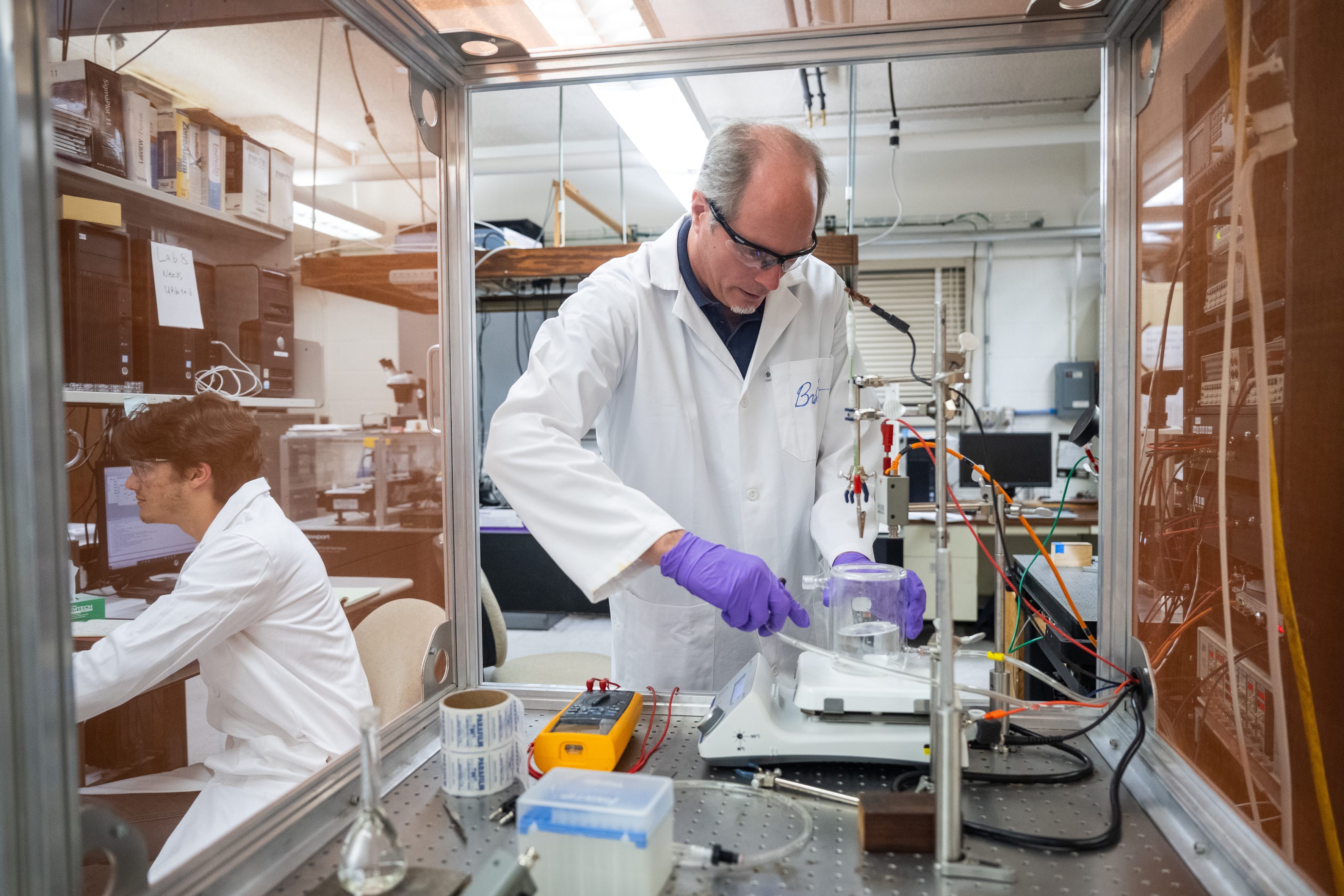
Bret Flanders has had an exceptionally impactful couple of years, playing a vital role in both departmental leadership and student mentorship. He continues to serve as co-director for our Physics REU (Research Experiences for Undergraduates) program. Alongside Principal Investigator Loren Greenman, Flanders not only co-led the program but also personally mentored two undergraduate students through their summer research projects. Beyond his dedication to the REU program, he successfully stepped in to teach the popular Physics Major Introduction (PMI) course, taking the reins from Dr. Brett DePaola. His immense service to the university community continues to grow in his newest role as Associate Head of the Physics Department.
Jeremy Schmit delivered a featured presentation, “Identifying cooperativity and emergent properties in DNA-protein interactions,” at an international focus workshop in Dresden, Germany. The workshop, titled The Non-Equilibrium Genome - Where Physics Meets Biology, was hosted by the prestigious Max Planck Institute for the Physics of Complex Systems.
To keep our curriculum at the forefront of modern physics, Amit Chakrabarti has spent the past year preparing to launch a new course centered on the quantum world. Open to both undergraduate and graduate students, the class explores the essential science driving the fast-growing fields of quantum computing and quantum information systems. Course topics will cover foundational and applied areas, including qubits, entanglement, Bell’s theorem, quantum gates, cryptography, and Qiskit simulations.