K-State Study Guide for Physics
Download this document in pdf.
Physics is the most fundamental of all sciences. It is the science of matter, energy, and the interactions between them. Discoveries in physics have applications throughout the natural sciences. Physics is at the root of every field of science, and underlies our understanding of all phenomena. Many of the problems that will need to be solved in the next decades will occur on the interface between physics and other related areas. Understanding and controlling new forms of energy, developing new materials for the next generation of computers, and improving methods of medical imaging—all these and more will certainly require a thorough knowledge of physics.
Career opportunities
A career in physics is rewarding and satisfying for people who enjoy solving problems by looking at the underlying basic principles. Physicists are trained to formulate their understanding of a problem or phenomenon in precise terms and to communicate these ideas to others. These skills are becoming increasingly valuable as our nation and the world depend more on science and technology.
Many physicists conduct basic research in industrial, university, and national laboratories, while others work in a variety of fields that require sophisticated problem solving skills. Some physicists teach in high schools, colleges, and universities. The physicists at colleges and universities often are among the leaders in basic research. About half of the students graduating with a bachelor of arts or bachelor of science in physics immediately begin careers.
Careers in performing basic research and careers in teaching at universities, however, generally require the additional training obtained with the master of science and doctor of philosophy degrees. Therefore, the other half of the students choose to continue their studies in graduate schools. Our graduates have built attractive careers in communications, laser development, medical research, the development of new energy sources, basic research in atomic physics and condensed matter physics, teaching, and numerous other fields. A list of our recent graduates and their career activities is available upon request.
We offer three different physics bachelor’s degrees. The B.S. in physics is the best preparation for advanced degrees, but the B.S. in general physics and the B.A. in physics offer a broad foundation in physics while requiring fewer physics courses, leaving room for other areas. Many physics majors simultaneously pursue an additional degree in areas such as math, computer science, engineering, or even philosophy. We counsel interested physics majors in obtaining their secondary physics teaching license during their studies, or in pursuing a minor in business or a master’s in business administration (MBA). Some physics majors pursue other minors or complete retirements for admission to medical or law school. More details
Our program of study has been designed to provide a firm, basic foundation in physics and mathematics. The program includes formal lecture courses, basic and applied laboratory courses, and regular seminars on our research projects. Our high ratio of faculty to physics majors, averaging one faculty member to three students, allows faculty members to interact personally with each student. Your education as a physicist actually begins in high school. To prepare yourself study all the English, science, mathematics, and computer courses available at your high school. Your first two years in our program will focus on both the basic courses required for any B.A. or B.S. and on the math and science courses that form a foundation for advanced courses in physics. These courses include calculus, differential equations, and physics. In your first year, you will start the sequence of introductory physics courses, Physics I–Mechanics and Sound and Physics II–Electricity and Magnetism. Simultaneously, you will be introduced to our faculty and current topics in physics through Physics Today (1cr./semester). Your second year, you’ll take Physics III–Modern Physics, as well as Mechanics and Advanced Physics Laboratory, where you’ll perform some experiments that were crucial in the development of contemporary physics.
The third and fourth years in our program will broaden and deepen your knowledge and understanding of physics. You will take courses in electromagnetism, thermodynamics, and quantum mechanics, and a laboratory course focusing on electronics/instrumentation. You may choose additional courses to broaden your physics knowledge in areas such as cosmology, contemporary optics, or particle physics. More curriculum details
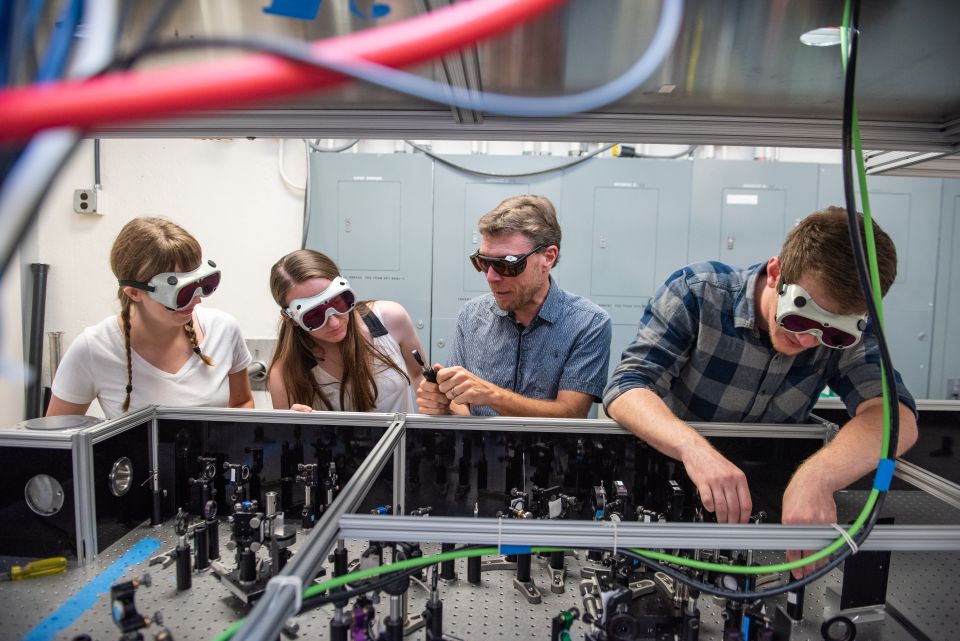
Most of our undergraduate majors participate in research by joining one of the research programs. This initial research experience helps our students with their career decisions and gives them the opportunity to use state-of-the-art research equipment. These students develop skills in computing, electronics, radiation detection, using lasers, building particle detectors, vacuum science, and other technically advanced areas. They present their research results both locally and at national meetings. Furthermore, most of our students are paid for their research time. Since 1990 our physics students have earned nine Goldwater scholarships, based largely on their involvement in research, as well as one Rhodes scholarship (1998), a Claire Boothe Luce fellowship (2004), and two NSF graduate fellowships. Whatever their eventual career, undergraduate research experiences are a valuable part of our students’ education. More details
Facilities
K-State possesses one of the most complete and modern facilities for physics education and research in the central United States. Each of the research groups of the physics department has its own state-of-the-art-equipment. The department has a computer classroom, a variety of computer workstations, and other facilities to support research and education. These facilities are available to our undergraduates.
Our research programs are diverse, ranging from providing basic atomic data needed for the national fusion energy program to obtaining basic experimental information on implanted semi-conductors that might be used as future solar cells to doing theoretical studies of how atoms are bound on solid surfaces. As a physics major you can be involved in one of the research programs listed here. See all the research available at K-State.
Atomic and molecular physics
Have you ever wondered how electrons and ions interact inside stars? We mimic the high temperatures found there by using accelerators and very high intensity lasers. Our group studies collisions among ions, atoms, and light, both theoretically and experimentally. Our national research facility includes a tandem Van de Graaff accelerator, sources of highly-charged ions, and an ultrafast laser giving the some of the shortest pulses of light in both the visible and x-ray regimes. By studying these collisions, we learn about the basic physics of atoms while also providing crucial data for astrophysics and the U.S. fusion program. We use ultracold targets made by laser-cooling atoms. Furthermore, we use ultrafast lasers and fiber optics to measure the frequency of light very precisely, in support of the telecommunications industry.
Soft matter physics
Controlled assembly of nanoparticles into two and three-dimensional solids, atoms and polymers adsorbed on surfaces, growth of nanowires and their interface to living cells, stretching single molecules, magnetic vortices and materials, nanolithography and nucleation of soot in flames; these are all among the many subjects of soft matter physics at K-State. Our eclectic soft matter group works at the interface between physics, chemistry and biology to understand how the manifold properties of soft matter emerge. Our research extends to biophysics and solid state.
Cosmology and particle astrophysics
Do you wonder how and why the universe started expanding? And whether this expansion is speeding up or slowing down? And how the very large-scale properties of the universe are related to the very small-scale properties of subatomic scale matter? The K-State cosmology group studies all these issues and more. K-State is studying measurable effects of the hypothetical dark energy, including how it might affect the cosmic microwave background radiation left over from the Big Bang. We also study the very young universe, which is thought to have expanded very rapidly during an epoch of inflation.
High energy physics
The K-State high energy physics program is trying to answer questions about both the smallest particles in the universe and about the universe itself. Our group studies these indivisible particles, which are smaller compared to you than a dust particle is compared to the entire solar system. These extremely small objects help us understand how all things interact. Studying the most fundamental objects in nature is a central part of the K-State program.
Physics education
You have probably noticed that some people can learn physics relatively easily while others seem totally mystified by it. This situation is not necessarily because some are ‘‘smart’’ and others are not. Instead, each group approaches physics with different thinking processes. The KSU Physics Education Research Group investigates these thinking patterns and conducts research on how students learn topics in physics. We are particularly interested in how students use information gained from everyday life experiences as they learn the laws of physics and how they make sense of abstract concepts. This research is then used to develop innovative ways of teaching. Usually our teaching methods involve the use of contemporary technology. Our goal is to make physics easier to learn for a wide variety of students and, thus, make it more attractive to them.
For more information about physics
Department of Physics
Kansas State University
116 Cardwell Hall
Manhattan, KS 66506–2601
(785) 532-6786
For more information about Kansas State University
Office of Admissions
Kansas State University
119 Anderson Hall
Manhattan, KS 66506–0102
(785) 532-6250
E-mail: k-state@k-state.edu
Notice of nondiscrimination
Kansas State University is committed to nondiscrimination on the basis of race, sex, national origin, disability, religion, age, sexual orientation, or other nonmerit reasons, in admissions, educational programs or activities and employment (including employment of disabled veterans and veterans of the Vietnam Era), as required by applicable laws and regulations. Responsibility for coordination of compliance efforts and receipt of inquiries concerning Title VI of the Civil Rights Act of 1964, Title IX of the Education Amendments of 1972, Section 504 of the Rehabilitation Act of 1973, the Age Discrimination Act of 1975, and the Americans With Disabilities Act of 1990, has been delegated to Clyde Howard, Director of Affirmative Action, Kansas State University, 214 Anderson Hall, Manhattan, KS 66506-0124, (Phone) 785-532-6220; (TTY) 785-532-4807.