NSF REU at K-State: Laser-matter Interactions at the Atomic and Nanoscales

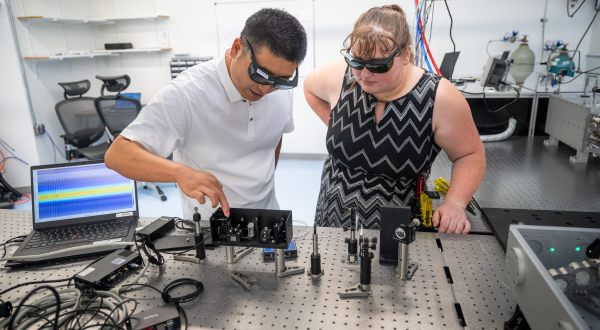
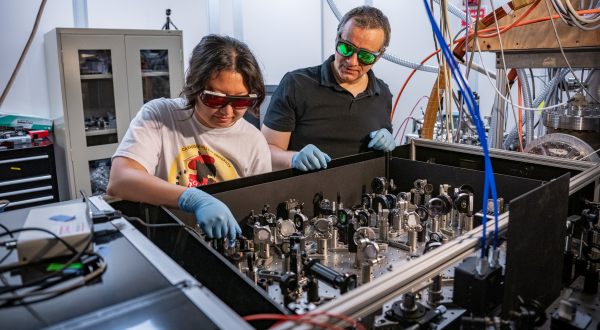
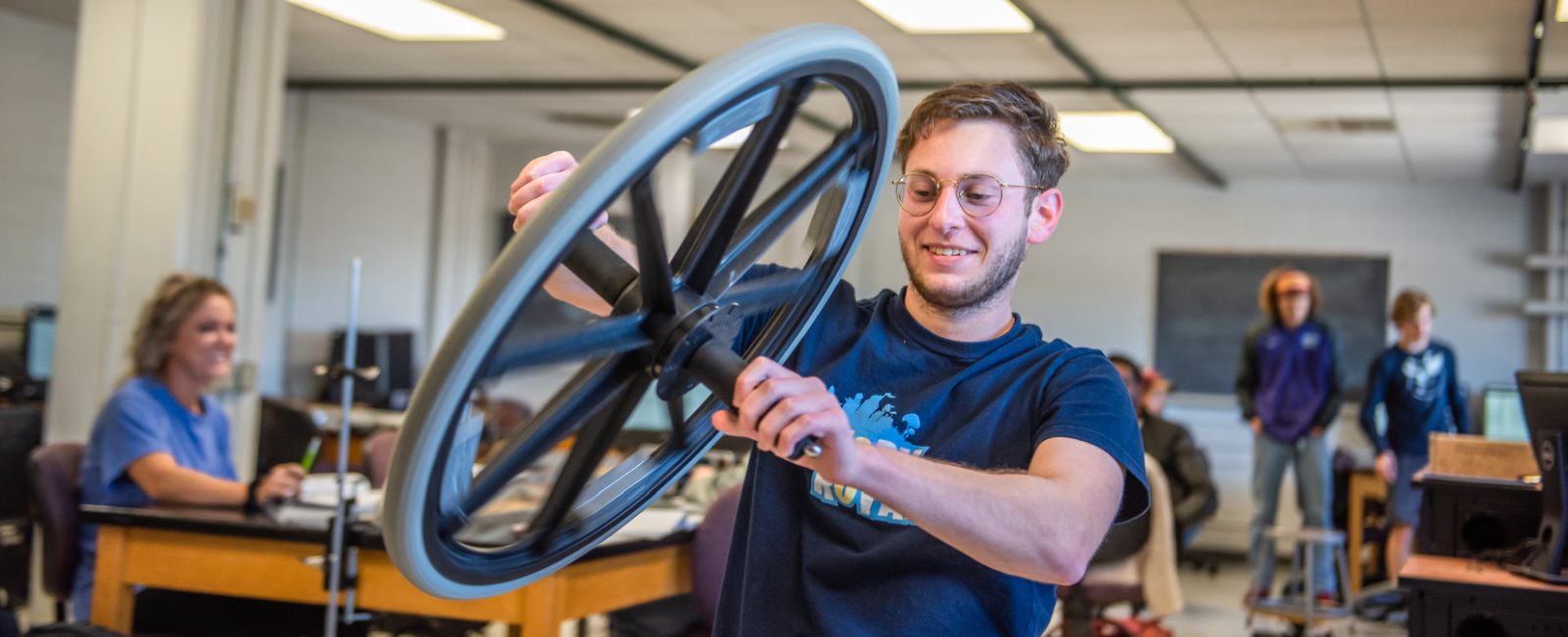
The K-State REU program offers summer fellowships to do world-class research in our friendly physics department in the scenic Flinthills.  We are funded by the National Science Foundation.

Atomic, Molecular & Optical Physics (AMO)  

Dr. Itzik Ben-Itzhak:  Ion beam bunching – the next generation of molecular dissociation imaging  

Email:  ibi@phys.ksu.edu 

During the 2012 REU program our research group will be involved in projects where undergraduate students can do interesting work and contribute to our research progress. Below I have briefly outlined a project which would best fit an REU student. This project involves significant technical development leading to advanced imaging of slow molecular collision processes, allowing us to increase the ion beam target density for our laser interaction studies. In addition, undergraduate students can get involved in other summer projects within our group[1].  Our research group includes my graduate students Nora Johnson, Mohammad Zohrabi, Utuq Ablikim, Ben Berry, and Bethany Jochim. The REU student is expected to work closely with them and under the guidance of Dr. Kevin Carnes and myself. Experience with any of these projects will provide the REU student exposure to research activity typical of what they may encounter in graduate school. [1] It is important to note that the specific involvement of the REU student in any of the projects will depend on the qualifications and interests of the student as well as our needs at the time.           


We are on a quest to measure the energy exchange in a slow charge-exchange collision (a few keV) between a molecular ion and an atom with vibrational energy resolution. So far, our measurements have employed continuous (DC) beams of ions, for which the time of collision is unknown. We plan to “bunch” the ion beam – that is, generate very short ion pulses, hopefully of about 1 nanosecond duration. This will allow us to conduct kinematically complete measurements of slow molecule – atom collisions. More importantly, this will allow us to ramp up the target density in our laser studies in which the ion beam serves as a target. The improved molecular dissociation imaging technique should allow us to resolve vibrational levels of the molecule. The REU project will involve designing, constructing, and testing the beam buncher and the devices used to monitor the ion-pulse duration. During idle times while waiting for the machining of parts, the student will participate in some experiments using DC beams in order to learn the relevant experimental techniques and also the physics describing these processes. For example, one such measurement is presently being pursued by a K-State undergraduate student, Adam Summers, and Ben Berry. It involves the alignment and orientation dependence of H2+ breakup by vibrational excitation in a collision with an argon atom.


[1] It is important to note that the specific involvement of the REU student in any of the projects will depend on the qualifications and interests of the student as well as our needs at the time.


Dr. Itzik Ben-Itzhak and Dr. Matthias Kling:  Characterization of Velocity Map Imaging for High Energy Electrons

Email:  ibi@phys.ksu.edu  or kling@phys.ksu.edu

During the 2012 REU program the research groups of Itzik Ben-Ithzak and Matthias Kling will be involved in research projects on the cutting edge of science.  Outlined below is a project suited for an REU student which involves conducting simulations of ions and electrons in a velocity map imaging spectrometer, technical improvements to the setup, and measurements of high energy (~300eV) electrons.  The student would be in direct supervision of graduate student Nora Johnson and post-doc Guillaume Laurent. Other members of the Ben-Itzhak group include Mohammad Zohrabi, Utuq Ablikim, Ben Berry, and Bethany Jochim. The Kling group includes post-docs Kelsie Betsch and Zhenhua Wang and graduate students Hui Li and Yubaraj Malakar. The REU student is expected to work closely with these two groups.        


Typically, velocity map imaging (VMI) consists of a simple design of two electrodes which, with the proper voltages applied, form an electrostatic lens that projects charged particles onto an imaging detector.  This design requires a long distance to the detector (capable of measuring ions or electrons) in order to achieve high resolution, therefore imposing a limit on the highest possible energies detected (about 100 eV for electrons).  A newly designed VMI setup consisting of many electrodes has been implemented, and it is expected to extend the measurable energy range for electrons up to 300 eV with excellent resolution.  The student would be responsible for conducting SIMION computer simulations to find the optimal set of voltages for the multi-electrode VMI spectrometer that yields the best resolution for a range of electron energies.  Finally, an experiment will be performed to test and characterize the multi-electrode spectrometer, hopefully leading to a paper before the end of the summer. 


This program is funded by the National Science Foundation through grant number PHY- 0851599.  Any opinions, findings, and conclusions or recommendations expressed in this material are those of the author(s) and do not necessarily reflect the views of the National Science Foundation.