Atomic, Molecular & Optical Physics (AMO)  

Dr. Itzik Ben-Itzhak:  Kinematically Complete Measurements of Slow Collisions    

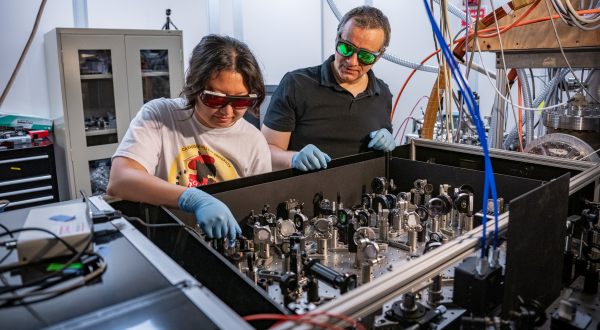
Kinematically complete measurements of slow collisions (Itzik Ben-Itzhak, AMO) – We are on a quest to measure the energy exchange in a slow charge-exchange collision (a few keV) between a molecular ion and an atom with vibrational energy resolution. So far, our measurements are limited to resolving electronic states a few eV apart. Therefore, an improvement by an order of magnitude of this experimental technique is needed in order to resolve states spaced by about 0.1 eV. The experimental technique relies on the measurement of all fragments of the molecule as well as the recoil ion. The REU project will involve simulating the trajectories of all particles involved through the apparatus. These simulations are crucial in converting the measured time and position information into the desired momenta of all fragments, from which the energy balance is determined. Furthermore, they will allow us to explore ways to improve the apparatus and the experimental technique beyond the present capabilities. In addition, the student can get involved in our ongoing measurements of electron capture in H2+ + Ar collisions using the existing setup.


Dr. Itzik Ben-Itzhak:  Imaging of Slow-Dissociation Processes in Intense Laser Fields    

We have recently developed a new molecular-dissociation imaging technique which allows measurements of very slow dissociation processes in molecular-ion beams initiated by intense ultrafast laser pulses. ”Very slow” in this context means that the dissociating fragments have energies on the order of a few meV in the center-of-mass frame of the molecule. The experimental method relies on the use of longitudinal and transverse electric fields to separate ions from neutral fragments in space and time. In order to improve the accuracy of these measurements, all the aberrations caused by these electric fields have to be accounted for. The REU project will involve simulating the trajectories of all particles involved through the apparatus. These simulations are crucial in converting the measured time and position information into the desired momenta of all fragments, from which the energy balance is determined. Furthermore, they will allow us to explore ways to improve the apparatus and the experimental technique beyond the present capabilities. Ultimately, these improvements will allow measurements of HD+ dissociation (into H++D or H+D+) with high enough precision to span dissociation from zero up to about 30 meV. In addition to performing simulations, the student will be encouraged to also get involved in some of the experiments themselves.


Dr. Brett DePaola:  Semi-Automatic Retrieval of Temperature and Density in a Magneto-Optical Trap

Email: depaola@ksu.edu

In many applications of a magneto-optical trap (MOT) it is very important to know the temperature and density of the cooled and trapped atoms.  In our work in particular, in which we study cold collisions, these two parameters are of paramount importance.  For example, the rate for photoassociation (the principle processes we are studying) goes as the square of the MOT density.   The basic technology for measuring these two parameters is well-known and is employed by literally hundreds of groups around the world.  However, to our knowledge, nobody has implemented these techniques with the following boundary conditions: (1) We want the measurement, including analysis, to be quick.  Because photoassociation depends strongly on the MOT density, we need to be able to quickly and accurately measure the absolute density. (2) We need the density measurement to be differential in r and z.  That is, a measurement of the density averaged over the MOT volume is not good enough.  (3) We need the experiment to be inexpensive.  That is, we want to be clever enough to use an inexpensive CCD camera costing a couple of hundred dollars, rather than the expensive ($40,000) CCD cameras used by most of the BEC community.  Thus, in addition to participating in the photoassociation measurements along with the rest of the group, the REU student will have as her/his own project: the development, construction, and testing of the temperature and density apparatus.   


Dr. Vinod Kumarappan:  Aligned Molecules

Email:  Vinod@phys.ksu.edu

AMO experiments in the gas phase have traditionally been done on freely-rotating molecules. Since these molecules are initially in eigenstates of the angular momentum operator; the angular positions of the molecules are completely indeterminate (angular momentum and angular position are quantum mechanical conjugates – they obey an uncertainty relation). This means that most experiments measured angle-averaged quantities, and detailed information about the angular information about any physical processes was often lost. During the last few years, ultrashort laser pulses have been used to overcome this limitation by launching broad wavepackets in angular momentum space (greater uncertainty in angular momentum) that align along a lab-fixed axis (less uncertainty in angle). By doing experiments on these aligned molecules, information about angle-dependent processes can now be obtained.

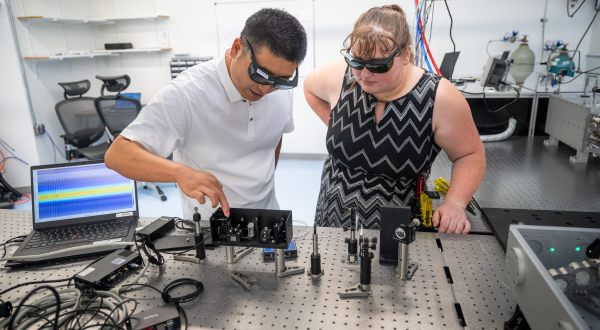
Our goal is to learn to launch wavepackets that produce well-aligned molecules. The REU project will involve building an optical setup to measure how well the molecules align. A gas cell has to be designed and built, and then molecules have to be aligned using a femtosecond laser, and the alignment measured using a non-linear optical process called the optical Kerr effect. The student will learn to work with ultrashort light pulses, to build and align a pump-probe experiment, and about revivals in quantum mechanical wavepackets.


Dr. Brian Washburn:  Dynamic high repetition rate carbon nanotube fiber laser frequency comb

Email:  washburn@phys.ksu.edu  web:  http://www.phys.ksu.edu/personal/washburn/

Optical frequency combs produced by pulsed lasers have recently become indispensable tools for exploring fundamental science.  An optical frequency comb is the frequency content of the light produced by a pulsed laser.  The comb can serve as a “spectral ruler” where each tooth can be used as a “tick” to measure an optical frequency.  We have recently shown that a novel fiber laser, which uses single-walled carbon nanotubes to create the pulses, can serve as a stabile source for a frequency comb.  The carbon nanotube fiber laser frequency comb offers much promise as a portable, robust, and inexpensive fiber frequency comb with further potential for scaling to higher repetition frequencies.  These features will allow frequency combs to make the transition from laboratory instruments to commercial systems. 

My REU project deals with the design and creation of a carbon nanotube fiber laser that has a repetition frequency that can be altered over a large dynamic range.  This is a unique opportunity to get involved at the ground floor with the creation of this novel laser.  Furthermore, the experience will be both educational and fun.  The student who will work on this project will learn about fiber optics, laser cavity design, carbon nanotubes, a bit of RF electronics, and nonlinear fiber optics.