Research
Atomic, Molecular and Optical Physics
Atomic, molecular, and optical physics (AMOP) is, as its name suggests, the
branch of physics that studies the interactions of atoms, molecules, and
light. AMO physics lies behind much of the physics of lasers and other
everyday devices. You may have recently heard about AMOP in connection with
the Nobel Prize in physics --- several recent prizes have gone to AMO
physicists.
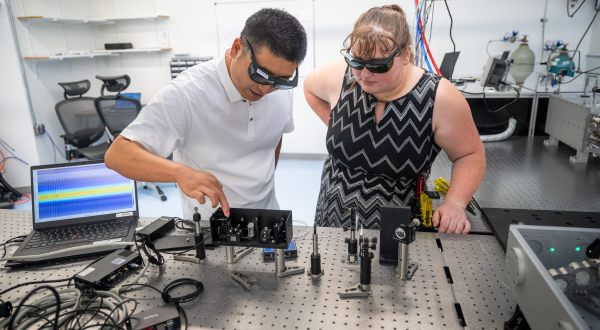
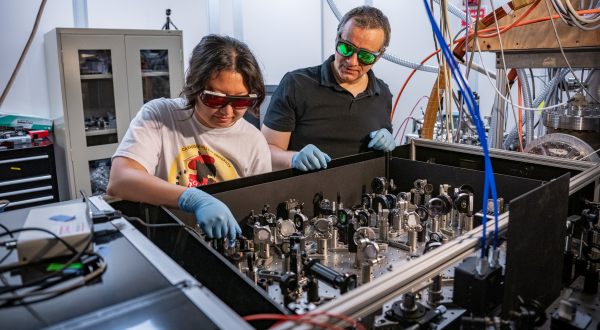
The KSU-AMOP program boasts one of the largest groups of AMOP faculty at a
U.S. university and is primarily organized around the J.R. Macdonald
Laboratory (JRML). The JRML houses several major facilities, including
the lasers of the Kansas Light Source (KLS), several ion sources, and ion
accelerators. The KLS is the newest addition to the Lab and has helped put
JRML at the forefront of ultrafast, intense laser science. Among other things,
JRML researchers are using the KLS to directly image electronic and molecular
processes, to generate attosecond laser pulses, to control and utilize the
carrier-envelope phase, to manipulate the generation of high-harmonics from
atoms and molecules, and ultimately to
understand the physics of intense lasers interacting with atoms and molecules.
Much of the KSU-AMOP theoretical effort is related to these topics as well.
KSU-AMOP faculty also engage in considerable research not directly connected
with the JRML. We have experimentalists working with frequency combs, for
instance, trying to produce improved frequency standards for the
telecommunications industry. Work is also underway to improve optical
fiber-based lasers. We have a theorist working on the physics of ultracold
few-body collisions and Efimov physics important for Bose-Einstein
condensation and degenerate Fermi gases, and another working on the
interaction of atoms and ions with surfaces.
For more details about the KSU-AMOP research program, visit
J.R. Macdonald Laboratory or some of
the individual pages below:
Experiment Theory Ben-Itzhak Esry Corwin Lin DePaola Thumm Kling Kumarappan Trallero Washburn
Condensed, Soft and Biological Matter Physics
Controlled assembly of nanoparticles into two and three-dimensional solids, atoms and polymers adsorbed on surfaces, growth of nanowires and their interface to living cells, stretching single molecules, magnetic vortices and materials, nanolithography and nucleation of soot in flames; these are all among the many subjects of soft matter physics at K-State. Our eclectic soft matter group works at the interface between physics, chemistry and biology to understand how the manifold properties of soft matter emerge. Our research extends to biophysics and solid state.
For more details about the KSU Soft Matter research program, you can visit http://www.phys.ksu.edu/CMS/.
Particle Physics
Have you ever wondered what the smallest indivisible particles of matter and energy might be? K-State particle physicists use some of the largest scientific instruments on Earth to measure the smallest constituents of matter and energy in the universe. Such elementary particles include quarks, which are the building blocks of the protons and neutrons in atomic nuclei, and neutrinos, which are practically invisible particles emitted by stars and decaying nuclei.
If you are interested in reading more about KSU Particle Physics you can visit http://www.phys.ksu.edu/hep/
Cosmology and Particle Astrophysics
Have you ever wondered about the physical properties of the universe on the
largest scale? K-State cosmologists study the structure and nature of matter
and energy on a literally cosmic scale using data from the world's most
advanced telescopes and satellites and scientific theories from every field of
physical science, including particle physics. Sometimes it is even possible to
use the cosmos itself as a scientific instrument: for example, an upper limit
on the
neutrino mass can be derived from the realization that neutrinos fill the
universe and yet do not cause it to collapse.
If you are interested in reading more about KSU Cosmology you can visit http://www.phys.ksu.edu/personal/ratra/
Physics Education Research
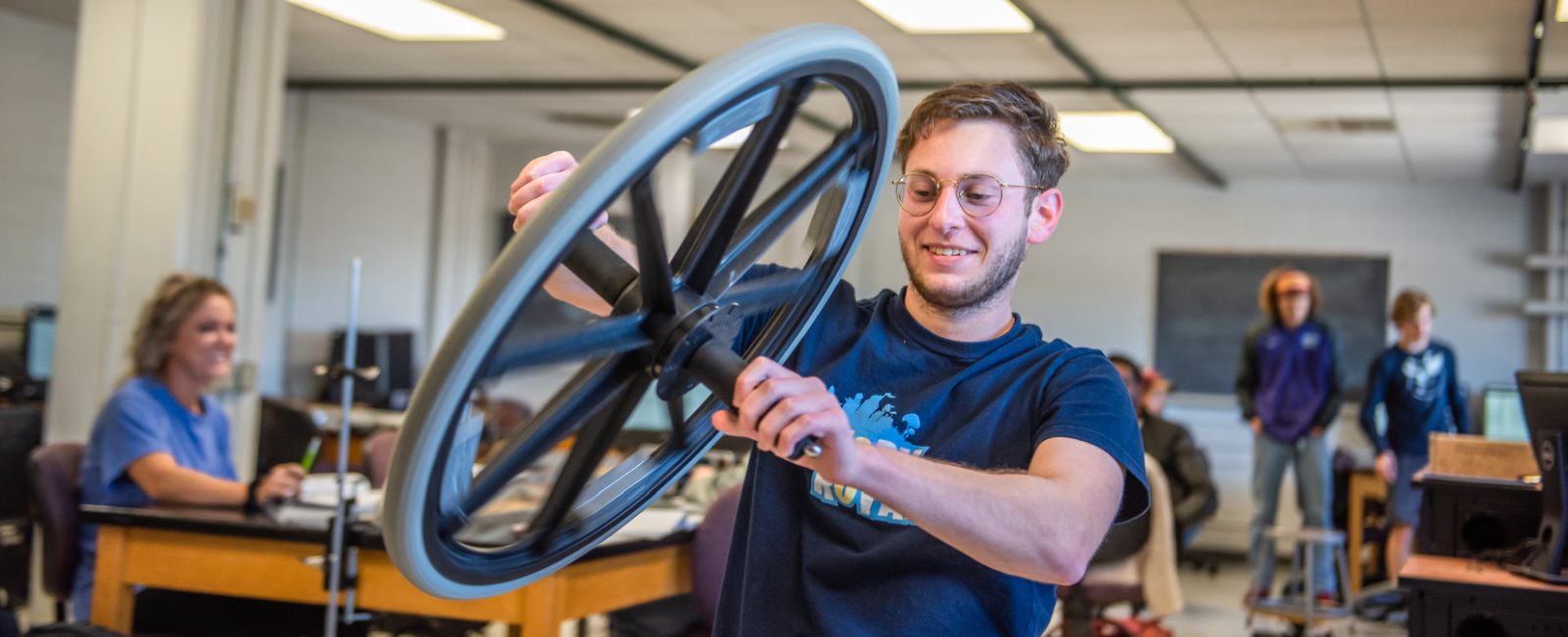
Have you ever wondered if there might be better ways to teach math and science? The K-State physics education research group is investigating ways of improving the teaching of science by using the perspective of research scientists. A central part of our effort is the study of how students learn physics. Only by understanding how learning occurs can we produce effective teaching materials.
If you are interested in reading
more about KSU Physics Education Research you can visit
http://www.phys.ksu.edu/perg/.