Kristan Corwin
Two-thousand
eight marked a high point for participation in the Research Experience for
Undergraduates, funded by the National Science Foundation. Fourteen
students came to Kansas State for 10 weeks to participate in research projects
with our faculty. The places they call home range from New York to Oregon,
from Minnesota to Texas, and from Missouri to Zimbabwe. Their research
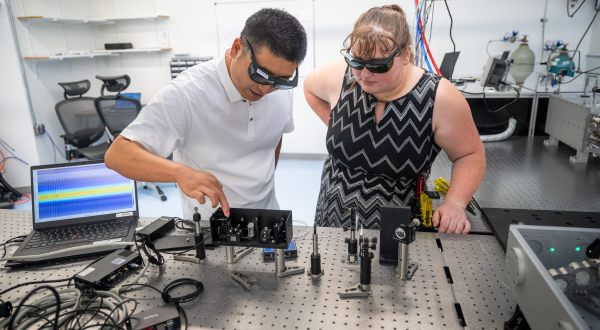
topics were also wide-ranging. In nanoscience, one student created
nanoparticles and studied their formation, while others used the same particles
to study the way they change color or the way they interact with polarized light
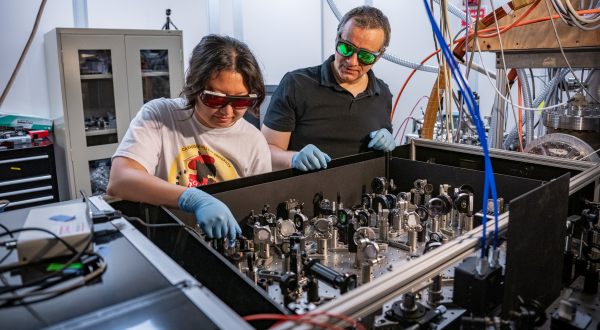
on a solution’s surface. Some students worked with lasers, including the
properties of a fiber laser that pulses because it has carbon nanotubes in the
cavity. Others designed spectrometers to measure the momentum of molecular
fragments after a molecule dissociates in an intense, ultrashort laser pulse
where the electric field of the laser is precisely controlled. Finally,
four students traveled to Japan at the end of the summer to participate in
on-going neutrino oscillation experiments.
The summer was
memorable for more than research. When the campus and particularly
Cardwell Hall were struck by a tornado on June 11th, students pitched
in enthusiastically to clean up the campus. Incidentally, this is not
unprecedented, because in 1993, our REU student helped clean up from a
major flood. Fortunately
we were back in the building pretty quickly, aside from a brief closure for
asbestos testing. Students also met to discuss the ethical issues that
physicists frequently confront, from graduate school selection to authorship in
publication and even scientific fraud, led by Philosophy Professors Bruce
Glymour and Amy Lara. They also attended information sessions on applying
for graduate school, led by the graduate school SUROP program. And of
course, they found time for ice cream socials, a trip to the Cosmosphere, a tour
of the K-State Nuclear Reactor, and a day-long canoe trip.
Dr. Larry Weaver has led this program since it was first funded in 1993 and Dr. Kristan Corwin joined the project in 2006. The year 2008 marks the end of a 3-year grant cycle, and we are delighted to have been recommended for funding for the next three years by the National Science Foundation. For more information, please visit www.phys.ksu.edu/reu.