Department’s Head
Corner
Dean Zollman
After a year of research and teaching (primarily research) in
Germany, I am once again in the Department Head’s office.
Except for a mishap on the ski slopes of the German Alps, my year away
was an excellent opportunity to concentrate on scholarly activities while
watching our Department move forward under the capable leadership of Amit
Chakrabarti. Amit’s willingness to
take on the leadership role made it possible for me to leave for a year and also
to return easily. Being at other
universities for an extended period helped me see the uniquely positive features
of our Department. The ongoing work
and support from our faculty, staff, students, alumni and friends provides a
remarkable place to study, learn and conduct research.
Among the events of the past year, two compete in my mind for “top billing.” One is the accomplishment of a faculty member and the other, the generosity of an alumnus.
Highlights of our
Achievements
Chris Sorensen was this year’s recipient of the National
Professor of the Year Award for research universities which is bestowed on one
faculty member nationwide by the Carnegie Foundation for the Advancement of
Teaching and the Council for the Advancement and Support of Education (CASE).
The Carnegie/CASE Award is open to all faculty in all disciplines.
This year over 300 nominations were submitted.
Chris was selected based on his life-long commitment to teaching,
particularly undergraduate teaching, and the strong support he received from
present and former students. More
information about the award is contained elsewhere in this newsletter.
As with most of the faculty in our Department, Chris combines
a strong research effort with his equally strong teaching.
You may recall from last year that Chris is also the President of the
American Association for Aerosol Research and received a prestigious award from
that organization just a few years ago.
This ability to conduct outstanding research and teaching is a trait of
our faculty that one does not find in every university physics department but is
present in most of our physics faculty.
Some of you may recall that I also received the Carnegie/CASE
award several years ago. Having two
faculty members in our Department receive this award makes KSU Physics unique
among all academic departments at all research universities.
Since the award began in 1981
only three universities – Rutgers, UC Berkeley and K-State -- have had two
faculty members receive the award.
Only at KSU have both professors been in the same department.
Another major event in 2007 was the largest gift that the Department has ever received from an alumnus. With a donation of approximately $1,000,000 Bill and Joan Porter endowed a professorship. Bill received a Masters degree from our Department in 1952. He had a very successful career in the application of science and technologies. In 1980 he turned his talents to business and finance. He founded the first on-line financial management service bureau which became E*Trade and most recently co-founded the International Securities Exchange, the world’s largest equity options exchange. Joan is the founder of Stillheart, a retreat center in northern California. Bill and Joan’s total financial support to our Department now exceeds $1.3 million.
Bill and Joan have visited our Department in recent years. In 2002 he inaugurated the Ernest Fox Nichols Lecture series for outstanding Physics alumni. Two years later he was the commencement speaker for the College of Arts & Sciences.
This endowed professorship is designated for the Head of the Physics Department. Thus, I am very pleased to have been named the first William and Joan Porter Professor of Physics. More importantly I am happy to consider both Bill and Joan to be friends and have enjoyed visits with them here, in San Francisco and Hawaii, including one memorable afternoon at the San Francisco opera.
The Department now has two endowed professorships.
The other is the Ernest & Lillian Chapin Professor.
Both of these endowments qualify for the State of Kansas Faculty of
Distinction program. Under this
program, the State provides additional funds each year for scholarly activities
related to the endowment.
Two good friends of the Department have provided endowments
for lecture series related to the mission of our Department.
As discussed in last year’s newsletter, funds from an endowment created
by Chet Peterson enable us to host a public lecture series on cosmology and
quantum physics. The first speaker
in this series, Lawrence Krauss, came to campus in March.
Dr. Krauss is well known for his research in cosmology as well as his
efforts to communicate physics to the general public.
His popular books include Physics
of Star Trek and
Hiding in the Mirror: The Mysterious
Allure of Extra Dimensions, from Plato to String Theory and Beyond.
An
endowment established by the estate of James Neff also brings outstanding
physicists to our Department. The
inaugural lecture in this series was delivered in April by Robert Austin,
Professor of Biophysics at Princeton University.
His lecture “Darwin meets nano” described how using nanotechnology can
help us better understand the physics behind DNA interactions and other
biological processes.
In 2007 nine undergraduates completed their physics degrees.
Bradley Belden, Adam Hupach, Eli Parke, Timothy Prascher, Adam Steiner, Jason
Tackett and Viatcheslav Zakjevskii were Spring or Summer graduates, while Daniel
Nickel and Arthur Bailey graduated in December.
As usual slightly over half (5) of our graduates are continuing their
education in Graduate Schools. This
year all of these students went to Big 10 universities – Illinois, Minnesota and
Wisconsin. Three of the
graduates are employed in the private sector while one is in the Army.
After two years of rather large incoming undergraduate
classes, we have a smaller one this year.
Eleven students started the 2007-08 academic year as physics majors.
During the past year nine students earned their PhDs.
They are Bijaya Aryal, Matt Brown, Shambu Ghimire, Chakra Maharjan,
Tahereh Mokhtari, Thomas Niederhausen, Marisol Alcantara Ortigoza, Flint
Pierce. and Mahendra Man Shakya. They have moved on to
positions as post-doctoral research associates, researchers at national labs,
private sector researchers and development and faculty positions.
Three students earned MS degrees: Diptanu Das, Brian Espino (lecturer at
East Tennessee State University) and Mojgan Matloob-Haghanikar (continuing
with PhD studies at KSU).
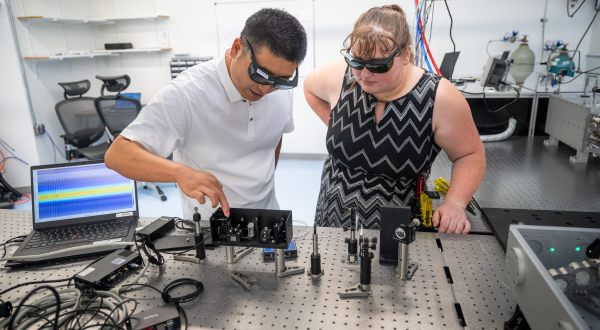
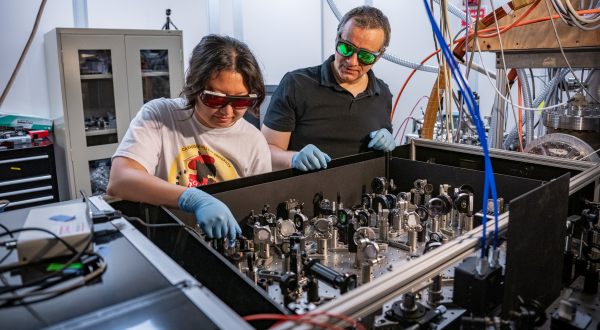
One new Assistant Professor, Vinod Kumarappan, joined our faculty in August. Vinod completed his undergraduate and graduate education in India receiving a PhD from the Tata Institute of Fundamental Research in Mumbai, India, during 2002. He came to K-State after a post-doc at Aarhus University in Denmark. Vinod is an atomic-molecular-optical physicist and is setting up a lab in the Macdonald Laboratory. His initial experiments will include aligning molecules (in the gas phase) using short, intense laser pulses, and then use these aligned molecules to study ultrafast molecular processes.
One senior professor, Talat Rahman, retired during the past year. Those of you who know Talat will be rather surprised to see the word “retirement” associated with her. She retired from KSU but has taken on a major new challenge. She is now Department Head at the University of Central Florida in Orlando, which has a very rapidly expanding physics department.
As with any teaching and research enterprise, changes are a necessary part of our efforts. However, the changes in our Department in the recent past and over the next few years have been and will be rather significant. Some of these transformations are part of the aging process. Many of our senior faculty came here in the late 1960s or 1970s and are reaching an age when they will retire. However, the largest transitions are related to the changes in the nature of physics research and our need to stay on the cutting edge. In turn these changes in research inform and require changes in teaching. At present, we are moving in the following directions:
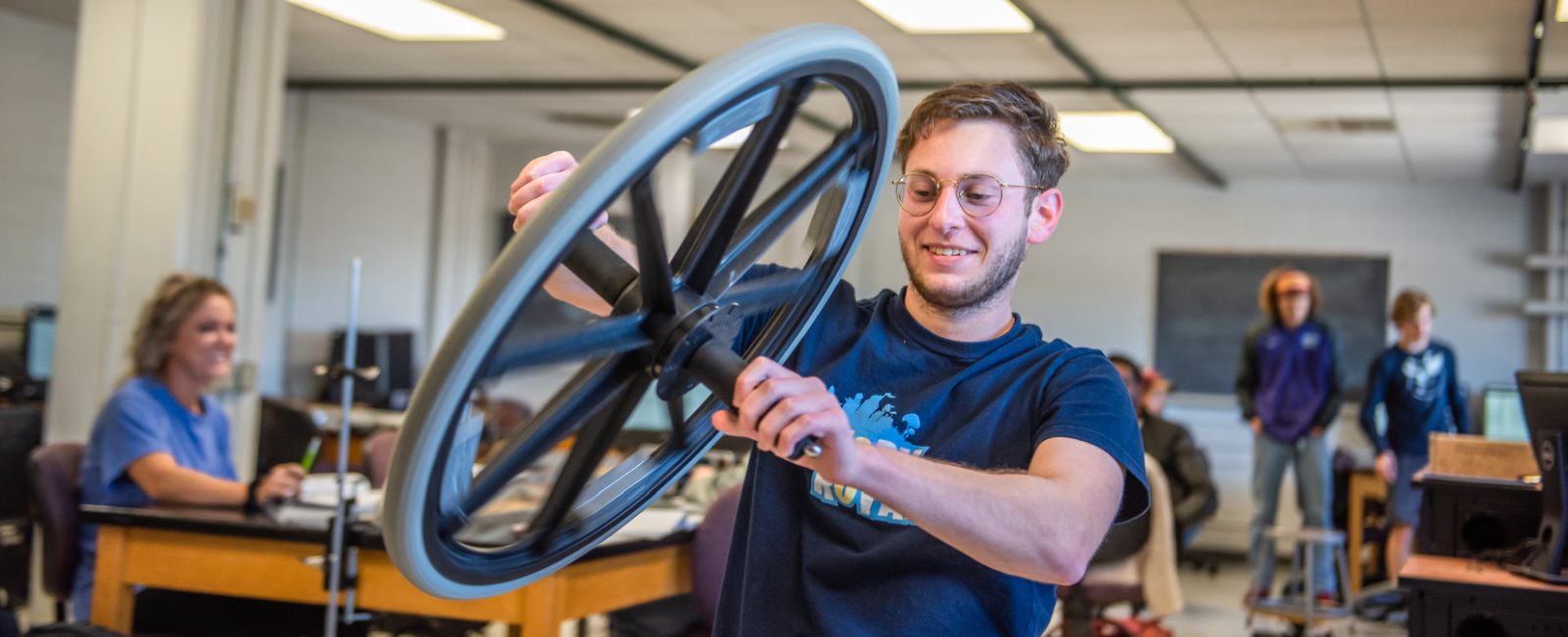
These changes are also reflected in our teaching. With funding from the National Science Foundation and a private gift we are implementing a sequence of three courses on contemporary optics. (NSF will fund new equipment and faculty time for curriculum development. Private funds were needed to bring the room up-to-date.) The students will start by studying basic optics; by the end of the sequence they will be actively participating in research in condensed matter or AMO physics. Likewise, we are beginning to look at content in our core courses with the goal of making sure that students are prepared for studies in topics such as nanoscale science and contemporary optics.
As we have for a long time, we continue to emphasize a strong research experience for our undergraduates as well as our graduate students. Most of our undergrads are involved in some type of research within the Department. This work which goes far beyond classroom learning helps our students receive prestigious scholarships, admission to high quality graduate programs and good job offers.
As you can see from my short report on Department activities, our alumni and friends play a major role in our successes and our continued efforts to meet the needs of our students. In addition to the specific gifts that I have mentioned, many of you have contributed to our undergraduate scholarships and to other programs in the Department. This year, as a result of an effort started by Amit Chakrabarti, we will be offering our first Alumni Research Awards for undergraduates. These awards will help bring more of our students into the research process. Thank you for all that you do for us.