K-State’s HEP group has been as busy as ever over the last twelve months.
On the research front,
our D-Zero experiment at Fermilab has now collected half an inverse femtobarn of
proton-antiproton collision data at Fermilab’s Tevatron accelerator, meaning
that we could now in principle observe processes with cross sections as small as
10-39 cm2! Impressive new measurements of the properties
of top quarks, W and Z weak vector bosons, and searches for hints of
undiscovered new physics such as supersymmetry are pouring out of the
experiment. K-Staters form a big part of the large international team running
the experiment. Post-doc Flera Rizatdinova leads a group measuring the top
quark production cross section. Post-doc Kristian Harder is in charge of
running the silicon microstrip tracker (SMT), a precision charged particle
detector for which K-State, led by Ron Sidwell, Noel Stanton, and KSU
Electronics Design Laboratory (EDL) engineer Russel Taylor designed and built
several key components. Graduate students Mahsana Ahsan and Mansoora Shamim
(working with Tim Bolton), and Mark Smith (working with Eckhard von Toerne) have
found time to begin the analyses needed for their PhD theses. The students also
spend three week periods as “DAQ shifters”, wherein they directly operate and
control the very complex and very expensive D-Zero detector and boss around
professors from all over the world. Mahsana and Mansoora have led teams
responsible for three of the top ten data taking days on the experiment; and
Mark will take his turn in a few months. An important new upgrade to the SMT
called “Layer 0” will be installed in the experiment in fall, 2005. Ron and
Russel produced major portions of the electronics for this device. Tim and
technician Robin Sidwell ran an important series of tests of the radiation
hardness of Layer 0 components. These tests were conducted using 10-14 MeV
proton beams at the KSU J.R. Macdonald Lab with the expert assistance of Tom
Gray, Kevin Carnes, and Al Rankin, and with the much appreciated support from
Pat Richard and Lew Cocke. And finally, Eckhard is part of the team tackling
the tough job of how to integrate this device into the experiment and get it
working as smoothly as possible.
D-Zero is not the only story at K-State. New assistant professor Glenn Horton-Smith leads an initiative to fully characterize properties of the now well-established phenomenon of neutrino oscillation. Glenn brings to us from CalTech and Japan world-class expertise in using the antineutrinos produced copiously at nuclear reactors to perform these measurements using multi-ton liquid scintillator detectors placed in underground mineshafts. He continues work on the seminal KAMLAND experiment in Japan, and with Noel and Tim, is developing proposals for new experiments in France and the US. The new America-based experiment will be located in Braidwood, Illinois, but there was considerable early interest in using Kansas’s Wolf Creek reactor in Burlington. Tim, Noel, and Dean Zollman held some interesting talks with the Wolf Creek management. Graduate student Jasmine Foster and undergraduate David Thompson are working with Tim on simulation studies of the Braidwood experiment. Undergraduates Jon Kaladimos and Chris Borjas work with Noel on measurements of properties of liquid scintillator in the High Bay.
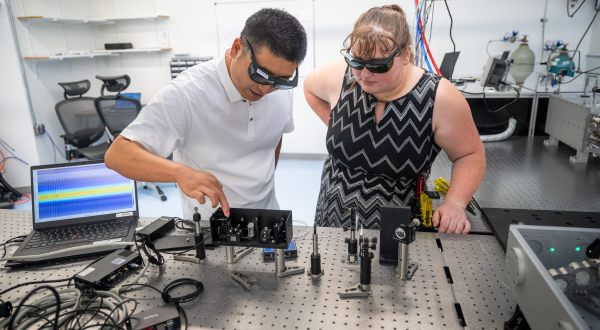
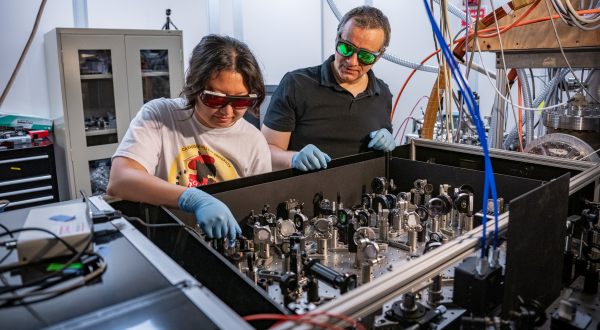
Eckhard von Toerne and post-doc Dima Onoprienko performed a series of studies of charged particle tracking at a future electron-positron linear collider that have won KSU widespread admiration in this physics community. Eckhard has also led, with post-doc Bill Kahl, Kansas State’s contributions to the future CMS experiment that will operate at the new 14 TeV proton-proton collider called the LHC, now under construction at CERN in Geneva Switzerland. As usual, K-State specializes in precision tracking with silicon trackers, in this case, the forward pixel detector system (FPIX). HEP and EDL personnel will test important components of the FPIX in our high bay clean room facility.
The
High Energy Physics group has responded to calls from national science leaders
to engage more of the public in our research with two major projects. Our
QuarkNet center brought 22 high school teachers from throughout the state to a
three-week workshop in Manhattan over the summer on topics in high energy
physics and education. The workshop also included strong contributions from
Sanjay Rebello and the KSU Physics Education Research Group. It ended with a
three-day “road trip” to Fermilab. Another High Energy Physics-led activity is
the Kansas State University Targeted Excellence project called the Center for
Understanding of Origins, which seeks to improve scholarship, education, and
outreach on topics like physical cosmology and biological evolution with an
interdisciplinary group from seven science and humanities departments at Kansas
State. “Origins” projects include a new undergraduate education course,
“Origins: Humanity, Life, and the Universe”, to be taught in fall, 2005;
recruitment of new faculty members; and a series of prominent outside speakers.
Program assistant Nidhi Mungali works on origins-related issues from her
home-base in the HEP group.
To close with some people
news: Graduate student Diptansu Das completed his MS degree with Ron Sidwell.
Undergraduate researcher David Thompson has been nominated as a Goldwater
Scholar. Former post-doc Todd Adams, now a faculty member at Florida State,
will marry in March. New undergraduate assistant Aubrie Koester recently joined
us to help our outstanding administrator Pamela Schremmer; Aubrie replaces Matt
Brungardt, who graduated after ably assisting Pam for the past two years. Bill
Reay continues to be active in physics education research and teaching during
his “retirement” at Ohio State. Noel Stanton will begin a phased retirement,
starting in fall, 2005; we’ll see how much he slows down! Finally, the big
announcement from our group is Eckhard receiving a 2004 Sofja Kovaleskaja prize,
described elsewhere in this newsletter. Eckhard will begin a two-year leave of
absence from us starting in fall, 2005. The university and department are
helping us fill this hole by pushing up the faculty search to replace Noel to
this spring.