Bruce Shore Gives October 2006 Colloquim at KSU

Bruce Shore

Dr. Bruce Shore was a Professor of Physics back in the 1970's. He returned to give a colloquium this past October. This is a report he wrote for his friends. We got his permission to share with all the Friends and Alumni of K-State Physics community.

Dear Friends,

Everybody knows that New York City --more specifically the borough of Manhattan -- is known as "The Big Apple".

Not so many people know that there is another, much smaller Manhattan, this one in the middle of Kansas, that has begun referring to itself as The Little Apple. Neither of these Manhattans grows any apples, but Manhattan Kansas does have much more agriculture than does its larger namesake.

Manhattan, Kansas, is home to Kansas State University (KSU), where I had a brief career as a Professor of Physics back in the early 1970s -- my only claim to that academic title. This week Randi and I visited this town, she for the very first time and me for the first time in more than 30 years. Following are some observations on that visit.

Kansas

Kansas, named for the Kansa tribe of Native Americans who inhabited the area, lies at the very center of the continental United States -- in fact, Osborne Kansas claims to be the geographic center of North America. Those who have not visited Kansas tend to think of it as rather flat and featureless. Indeed, the western portion of the state, like the contiguous eastern edge of Colorado, does fit that stereotype. In that region Salina, Abiline and Dodge City are justly known for their historical connection with the cattle drives and lawlessness that have provided themes and plots for so many Westerns -- novels and movies. (Think Wyatt Earp and Doc Halliday at Dodge City, the Dalton Gang at Coffeyville.)

But the eastern portion of the state, continuing the topography of Missouri westward to nearly as far as Manhattan, is marked by rolling terrain -- not really large hills, but definitely with slopes that would make a bicycler work -- and a good deal of deciduous tree cover. In the fall one sees quite lovely colorings of the trees, making early October the best time to visit.

One sees, in that eastern portion of Kansas, a good many small farms, complete with tall red silo and white barn. There are numerous small lakes and rivers, where I understand the duck hunting is good.

To a Californian, the most notable aspect of the terrain is the very attractive environment of the excellent motorways, on which there are no traffic jams. By California standards there are almost no trucks and very few cars. Whereas the interstate highway past Livermore is 10 lanes, busy day and night and impassible morning and evening, Kansas has only a brief stretch of 6 lane turnpike; the interstates are just 4 lanes. It is a very pleasant network on which to drive. And drive one must, for no longer is there any  passenger rail service to the towns of Kansas, as once I enjoyed (The train stations have, in many cases, been restored and converted to local museums). The towns are small and far apart. The residents definitely appreciate the unpopulated nature of life in Kansas, but are remarkably friendly to everyone -- fellow elevator passengers in the motel inevitably ask about your business.

Many of the highway cuts expose underlying strata of cream-colored Kansas limestone. One sees this material used in the construction of many public buildings -- it is a recurring theme, making for a definite sense of Kansas identity.

Manhattan itself is sited in the Flint Hills region, where tall-grass prairie competes with stream-fed copses to provide, from gentle hilltops, scenes of truly extraordinary beauty.

Kansas became a state in 1861, following considerable armed strife between the two factions that were shortly to conduct the great War Between the States. Kansas entered the union as a free state, but suffered many bloody clashes with marauders from neighboring Missouri. Not without reason was it known as "bleeding Kansas".

There are many interesting tourist attractions in Kansas. Amongst these is the worlds largest painting of sunflowers (the Kansas state flower), a 24' x 32' reproduction of a Van Gogh painting, in Goodland.  At the right time of year one can visit half a dozen large mazes constructed in corn fields. One can see wagon ruts from the Oregon Trail and the Santa Fe Trail. One can see, but probably not pet, buffalo, and one can ride in stagecoaches or re-enact old cattle drives.

At one time there were active oil and gas fields in western Kansas. Nowadays there are 4 or 5 wineries.

The major cities of Kansas are Kansas City KS (across the Missouri river from the larger Kansas City MO where the professional athletic teams center), Wichita, Topeka (the state capital) and Salina.  From days of the great cattle drives come such historical places as Atchison (think Atchison, Topeka and the Santa Fe rail road) and Dodge City. One can find, amongst the smaller towns, such names as Lincoln, Washington, Columbus, Newton, Pleasanton, Stockton, Hanover, Frankfort, Minneapolis, Madison, Liberal and Flush. >From the days of the native American persecution come Forts Hays, Leavenworth, Dodge, Riley.

Kansans

A number of individuals known to schoolchildren of my era are associated with Kansas. Assisted by the Official Visitors Guide to Kansas, I list here a few of those.

Kansas sights

Most Kansas towns have a local museum, often housed in a former Carnegie library or a former railroad station  that has been restored. Amongst the more noteworthy places one might visit are the following (again, the visitors guide provides this information):


Kansas events

Hundreds of events throughout the year offer activities of interest to both tourists and locals. Nearly every town has at least one event each year. These include, along with such traditional events as Old Pioneer Day, Native American Pow-Wows, music festivals,   harvest and Christmas festivals, the following annual events (listed in the Visitors Guide):

Manhattan

The town of Manhattan, not far from the center of Kansas, dates back to the late 1850s. Nowadays it claims a population of 45,000, and it is said that KSU has 22,000 students. So the town is quite definitely dominated by the university and its students. There is no other obvious income base, apart from nearby Fort Riley, which provides the support for the adjacent town of Junction City.

The town has grown steadily over the years. Within a traditional rectangular gridwork pattern, one finds street after street of one- and two-story homes shaded by enormous trees. A visitor gains a very positive impression from these.

There is a traditional commercial core, several blocks long, which one recognizes as a rather typical small town as seen prior to, say, 1960. There one finds the city hall, the library, the Methodist church, the Congregational church, and what was once the hotel (now apartments and an upscale restaurant) and cinema. The one-story commercial buildings that line two or three blocks are like those of First street in Livermore, before it was revised this last year to make it pedestrian friendly. This main street (Poyntz Ave) comes to an abrupt end at what turns out to be one end of a very large enclosed mall, within which one finds a very nice, very typical mall. All of that came after my years in Manhattan, when serious shopping meant a two-hour drive to Kansas City MO. This mall development has allowed the old downtown to survive, although not without some obvious pains.

The university lies several miles to the northwest of the "downtown". Adjacent to the campus is a small commercial center some two blocks long, claiming some hundred shops (one third of which exist primarily to dispense beer), known as Aggieville. It is here that students are to be found whiling away evenings, or patronozing Varney's bookstore for textbooks and purple apparel.

Kansas State University (KSU)

The university dates from very early in the life of Manahttan -- it was one of the early universities to take advantage of the Morrill Act of 1861 which provided federal support for Land Grant Colleges. It claims 1863 as its founding, when it took over an earlier Bluemont College -- a methodist college like my own alma mater.

Kansas, like many of the states west of the Mississippi, has two major state-supported universities: University of Kansas (KU) and Kansas State University, and dozens, perhaps hundreds, of much smaller colleges.  Originally KU was a more traditional university while KSU was an agricultural college (Kansas State Agricultural College), and these origins are still visible in the nature of the departmental structure. For example, while both universities have such things as Arts and Sciences (physics and chemistry amongst other things), KSU has a great deal of activity in veterinary medicine and grain production. Last week the university dedicated a new state-of-the-art grain mill, so that students could remain on the cutting ege of the milling business. (That pun was from the university president).

Rodeo is a varsity sport at K State; there is an indoor arena where events occur.

Purple Pride 

KSU has a football team -- the university is a member of the big 12 conference -- and during the fall this provides the center of much attention. The school color is purple, and one sees purple clothing and accessories sported by many of the young people. Purple Pride or, in more recent years, Purple Power, is visible everywhere. Entire stores are devoted to selling purple objects to wear or use or eat from or drink from.

Back in the 1970s KSU, like my own alma mater College of the Pacific (now Univ. of the Pacific) had a logo based in a somewhat comic cartoon character of an animal. At Pacific the animal was a tiger. At KSU it was a wildcat. The two cartoon characters might well have been created by the same artist, perhaps the creator of Bugs Bunny.

Some time in the last decades both schools decided to modernize their logo, and both of them seemingly consulted -- again -- the same artist. One sees, in each case, a very stylized pattern that, with proper attitude, can be interpreted as a wildcat or tiger, respectively. In each case the emphasis is no longer on cuteness but on ferocity.

The difference in the two schools is quite apparent. Whereas Pacific abandoned its football program some years ago, KSU continues to strive for success on the gridiron. In consequence, the fall activities definitely center on football. During our visit the students were preparing for the annual "homecoming". Huge posters along one of the walkways, prepared by the several living groups, portrayed interpretation of the theme this year: "Homecoming Heroes".  The school newspaper interviewed some students to determine who their heroes were. All but one of the women  selected their mother; the exception chose Mother Theresa. The young men were almost as enthusiastic in selecting their fathers; one chap chose the Pope.

About one third of the students belong to "greeks", meaning a fraternity for the males and a sorority for the women. About half of the studentbody officers are "greeks". The gradepoint average of fraternity men is said to be higher than the class average.

In my day at KSU one could swim in a cavernous basement pool, rather unappealing. But the building was burned down (arson) during my first year. Now there is a very nice indoor pool -- actually two lap-swimming pools and a diving pool.  I think that water polo is played.

The "old" campus occupies about a square mile, and includes buildings dating back to the founding. All of them are either constructed of Kansas limestone or are faced, in part, with that material. So there is a sort of uniformity to the feel. Lots of trees and lawns separate the buildings; on a nice fall day it is very pleasant to stroll around.

Many of the buildings use romanesque arches in various ways -- rather reminiscent of the architecture of the Quad at Stanford. But some of the older buildings  employ crenellation that gives the impression of some castle. The very oldest building  might have been designed by Charles Addams.

The newest buildings maintain the feel of the older ones, but can do so in ways that are very attractive in their own right. There is a splendid  new library building, very nice indeed, and very nice new art library. The newest building on campus is a truly splendid alumni center, one of the finest designs I have seen: it incorporates the Richardson style arch in beige Kansas sandstone, a lovely roof too, while being very clearly a contemporary design. Quite obviously the alumni have provided a lot of money -- their names appear on bricks or plaques throughout the structure.  One room inside is devoted to memorabilia: a band uniform from 1952, a purple cape worn by some homecoming queen, an old football helment, etc. etc.

On Tuesday afternoon as I was walking across campus I could see, and hear, the marching band, more than a hundred strong, practicing their routine in the old stadium in preparation for the half-time show at the football game on Saturday. Very impressive; it might almost have been Pacific of the 1950s.

Physics at KSU

When I arrived as a member of the faculty at KSU the physics department was just beginning to make use of a major "atom smasher", a tandem Van de Graaf ion accelerator used as a tool for studying nuclear reactions. This was a remarkable facility for a place as small as K State. Rather like having a Wurlitzer theatre organ in your front room at home, it not only dominated the research program but placed K State amongst the major research institutions in the US.

However, within a few years the funding patterns of federal research began to shift away from nuclear physics. The folks at K State anticipated difficulties with future funding, and so they undertook a major shift of emphasis, away from nuclear physics and into atomic physics, still with the use of their large machine. By so doing they became unique, and succeeded to continue doing outstanding research while other groups had to close their accelerators for lack of federal support.

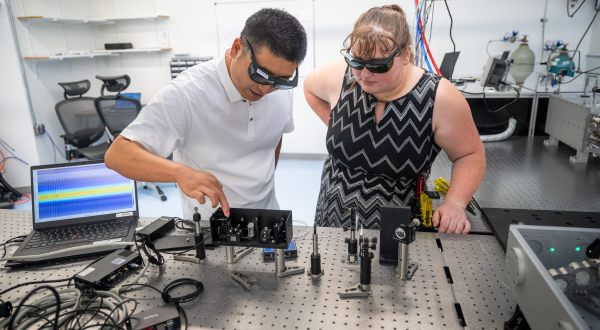
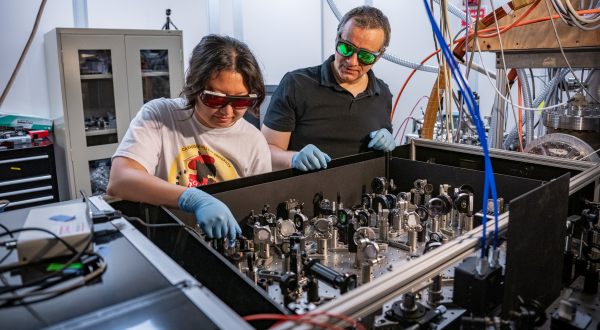
Now they are undergoing yet another major shift. They have constructed "The Kansas Light Source", a very fine state-of-the-art laser. They use light from this laser, together with the various experimental stands that have been created earlier, to move into new areas of research.

My own research in recent years has been on developing theoretical descriptions of how laser light affects individual atoms. This work is very much in line what what many of the researchers at KSU now do. Thus there is considerable overlap in our research interests, and I enjoyed two days of meetings with faculty. Only one of them, my host Lew Cocke, had been a colleague in the old days, but several others I knew by reputation or had met at some time. As is customary, I was shown the laboratories: large vacuum chambers where beams of atoms pass or are trapped; tabletops filled with lenses to guide laser beams.

The entire facility, including the original Van de Graaf and all the associated target chambers, is housed in the basement of Cardwell Hall, the physics building, and  is known as the James R. MacDonald Laboratory --memorializing  a former colleague of Lew and I. In the basement there is a picture of Jim, seemingly eager to share some bit of physics. It was eerie, for on looking at the photo I imagined I could hear his voice, at one of our Friday afternooon end-of-the-week relaxations at the "faculty club" of the Ramada Inn.

I presented two talks to the physicists. The first was one of the regular Monday afternoon departmental colloquia. It was in one of the large lecture rooms, where for two semesters I lectured to non-scientists in a course called Man's Physical World (or PWorld). The next day I gave a somewhat shorter talk in the small room where we used to meet for faculty meetings.

The Former Shore Home

On Tuesday afternoon I proposed to visit the home which my first family and I occupied, on Leslie Lane. At the time of my occupancy this fairly new one-story red brick house lay on the outskirts of town. Being a new development the neighborhood was quite barren of trees. We had a broomstick of a single tree in the back yard, and a similar one in front. I always had the impression that we lived out on the prairie.  The lack of windbreak made outdoor dining quite unpleasant for much of the year, discouraged by spring winds and summer heat .

Nowadays the border of town, and the newer developments, has moved several miles to the west. The old neighborhood now is fully foliated. Huge trees provide shade everywhere. Only after consulting a map in a gas station was I able to navigate successfully to the old home. The house is basically unchanged, but it is now sheltered by trees on all sides. In the back yard is a tree whose girth exceeds my reach. The entire neighborhood now is very much like the older residential area of town that I so much admired back in the 70s.

It is but a short walk from that house to the Marlatt elementary school. Nowadays the route still lacks sidewalks, but  the huge trees make the walk a pleasant one.

Conclusion

Any visit is always improved if you are hosted by old friends, whether the locale be Armenia, Bulgaria or Kansas.  Randi and I needed no guidance to the customs of middle America, of course; it was easy to understand, through conversations and reading of the student newspaper, a bit about the very friendly lifestyle that has drawn our friends Ron and Jean Lee back to Manhattan for retirement from Livermore. In October life seems very good in Kansas.