Research Strategy
Degenerate Four Wave Mixing Experiment
In the optical
experiment, we use three probe beams and one pump beam to align and study the
molecule. The experiment is non adiabatic, meaning that the laser field is quickly
applied to the molecules and then removed, so that the molecules may rotate
field free.
After the molecule interacts with the pump
beam, it is examined by using the three probe beams. The three probe beams
cause the “four wave mixing”. Four wave mixing is a 3rd
order nonlinearity, in which at least two different frequency components
propagate in a nonlinear medium. A refractive index modulation in the frequency
occurs, and creates two additional frequency components:



In sum, four wave mixing is the interaction of four electromagnetic waves
via 3rd order nonlinear polarization. When all of the waves have the
same frequency, the system is called “degenerate”. In our experiment, a photon
is gained from each probe beam—producing a fourth photon and the signal beam.
The alignment and orientation of the molecule is determined from this signal
beam.
More specifically, the alignment of the
molecules is determined by the change in refractive index. The probe beams
refract off of the molecules, giving a signal depending on the refractive
index. The signal is analyzed using a LabVIEW program, which graphs  (alignment) and
 (orientation); where
 is the angle the molecules make with the lab
axis. From these graphs we determine
where Iodobenzene has full, half, or quarter revivals.
is the angle the molecules make with the lab
axis. From these graphs we determine
where Iodobenzene has full, half, or quarter revivals.
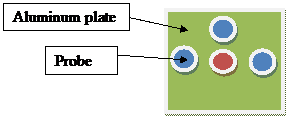




Pump beam beambeam
Iodobenzene is an
asymmetric molecule ( that
has its own three dimensional axis. We study the alignment and orientation of
the molecules with respect to the lab’s axis. This requires
a transformation of the molecule’s frame into the lab frame. This is done by
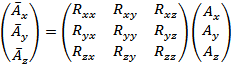
using tensors and transformations. For our
experiment, we use a fourth ranked tensor, meaning that the molecule’s axes
must be multiplied by four rotational matrices to be transformed.
that
has its own three dimensional axis. We study the alignment and orientation of
the molecules with respect to the lab’s axis. This requires
a transformation of the molecule’s frame into the lab frame. This is done by
using tensors and transformations. For our
experiment, we use a fourth ranked tensor, meaning that the molecule’s axes
must be multiplied by four rotational matrices to be transformed.


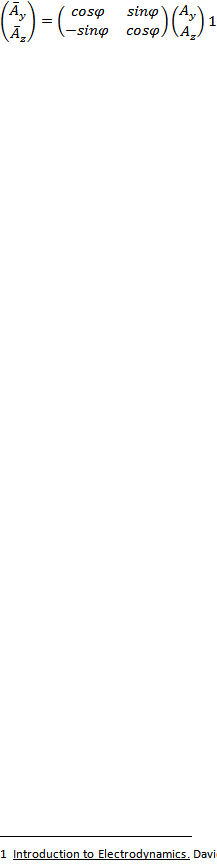
Original axes Transformed axes Rotational matrix
General form:

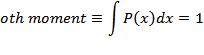
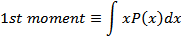
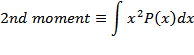
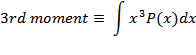
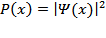
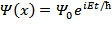
The probability function is calculated from the 3rd moment:

One benefit of the degenerate
four wave mixing experiment, is that it requires fewer assumptions made on the
molecule’s alignment after sending in the pump beam. Also, this optical
experiment can be used to study the structure of almost any molecule.
However, from this
experiment one cannot acquire the alignment data directly, since one must first
calculate the moments to get the probability function. Another drawback to the
optical experiment is that it requires a much higher gas density than the VMI.
Two Color VMI Experiment
In this experiment, there is one pump beam and one probe beam. The pump
beam has a mixture of blue and red, whereas the probe beam is purely red light.
The red and blue are originally polarized perpendicular to each other, with the
blue polarized in the horizontal. The red and blue is created to have an
asymmetric laser field. This asymmetric field aligns the molecules, by
supplying a torque which causes the molecules’ angular momentum states to
change.
After the two colored field is turned on for a short time, a second beam
(the probe beam) Coulomb explodes the molecules. Valence electrons responsible
for chemical bonding of the molecule can be stripped from the atoms, given a
laser beam with high enough intensity. The mutually repulsive state between the
atoms, whose chemical bonds are broken, causes the molecule to explode into a
plasma cloud of energetic ions.
In the case of Iodobenzene, I+ separates from the benzene ring and hits a
MCP (multi channel plate) which causes a shower of electrons to hit a phosphor
screen and create an image. From the image of I+ and Iodobenzene+ the alignment
and orientation is calculated using LabVIEW. The probability function, P(x), is
calculated directly.



MCP
Electron
shower

Phosphor screen
One disadvantage of VMI is that one must know how the molecule will
separate after Coulomb explosion. The molecule must follow axial recoil,
meaning that the ions must separate along their axis. All molecules do not obey
axial recoil; hence the reason why the optical experiment is used in accordance
with the VMI.
In sum,
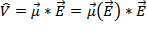
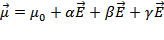
Dipole potential:
 +…
+…
Where  are
tensors and
are
tensors and  is the
dipole moment
is the
dipole moment



