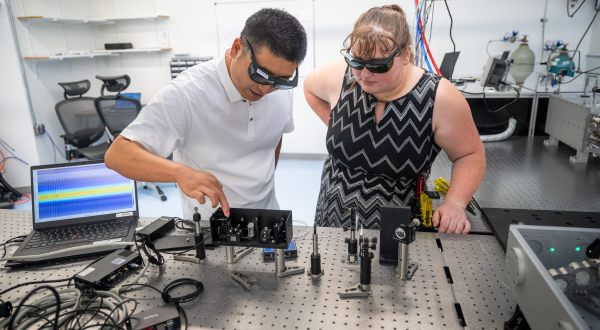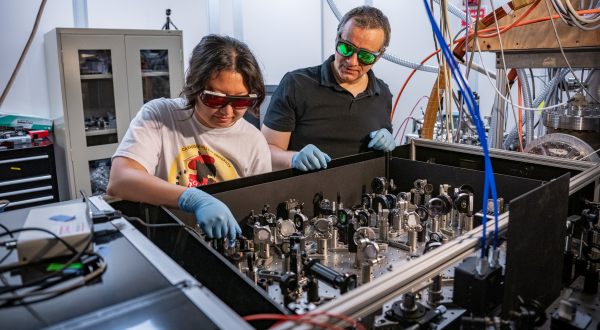
Kyoung Hoon Kim received the “Outstanding Performer Award,” from The Department of Defense in recognition of his outstanding performance and dedication as a contractor under the DARPA/MTO SUVOs program. Kyoung is a graduate student with the semiconductor group of Dr. Hongxing Jiang and Dr. Jinyu Lin.
![]()
Matt Berg received a
fellowship from NASA Graduate Student Research Program (GSRP) for graduate
studies leading to a masters or doctoral degree in the fields of science,
mathematics and engineering related to NASA research and development. The
award was given based on academic transcripts, research proposal, Faculty
Research Adviser’s recommendation and the proposed utilization of the NASA
Center or university research facilities. Matt is a graduate student working
with Dr. Chris Sorensen. His proposal was entitled, “Light Scattering by
Nonspherical Particles.” Matt's was one of six fellowships awarded out of
approximately 70 proposals submitted. The fellowship provides Matt with a
stipend, tuition and book allowance, and travel funds. Part of the travel
includes visiting and working with Dr. Michael Mishchenko at NASA Goddard in
New York City. Dr. Mishchenko is an expert in light scattering theory.
Contingent upon satisfactory progress, Matt will be eligible for two
additional years of support. The fact that Matt was one of the students
funded is a truly a mark of distinction. To read more about the NASA GSRP see
http://fellowships/hq.nasa.gov/gsrp/program/.
![]()
Mindy
Koehler, a senior physics major, received the Clare Boothe Luce
scholarship. Selection for the scholarship was based on the applicant’s grade
point average, honors and awards, membership in honor and professional
societies, leadership roles, letters of recommendation, two essays and
personal interviews. This scholarship encourages women in engineering and
sciences. Mindy will receive $18,000 per year for two years.
![]()
Undergraduate Student Studies Single and Double Ionization of Water
The Developing Scholars Program is in its fifth year on campus. DSP is an undergraduate research opportunity program targeting underrepresented populations (students of color and first generation college students). DSP matches selected students with faculty research mentors who provide an early introduction to a student’s field of study as well as providing academic, social, and financial support. In this way, DSP hopes to open many opportunities for students and help prepare them for graduate work and professional schools. Students can be in the program up to three years during which time they are paid a stipend. Summers are free so they can participate in other programs such as McNair Scholars and Pathways, among others.
The aim of DSP is to
foster students’ active participation, alongside a faculty mentor, in the
discovery and creation of new knowledge at KSU and to increase the pool of
bright, well-prepared students from underrepresented backgrounds
for graduate studies. Matt Leonard, junior in physics and
undergraduate assistant of Dr. Itzik Ben-Itzhak, is in his final year of
eligibility with the Developing Scholars Program. Matt’s work has been on the
Isotopic Dependence of Bond-Rearrangement in Single and Double
Ionization of Water.
The Kansas NSF EPSCoR Summer Research Program coordinates with the McNair Scholars programs in Kansas. Six students from groups underrepresented in the sciences are supported for a summer research internship at K-State, KU, or Wichita State University. Last summer, Matt was one of three EPSCoR undergraduate researchers at K-State. As an EPSCoR participant, Matt also received instruction in preparation for the GRE, wrote a report of his research, conducted under the guidance of Dr. Itzik Ben Itzhak and Dr. Kevin Carnes, and presented that research at the Heartland McNair Research Conference in Kansas City last September.
The McNair Scholars Program at K-State, now in its tenth year, is designed to prepare students for doctoral study. This fall, Matt began participation in the McNair Scholars Program at K-State. Initially, McNair participants attend a Colloquium on Research and Graduate Education. For each subsequent semester of the two-year McNair Scholars Program, participants attend a weekly McNair Seminar class. They also receive support to attend research conferences and to visit graduate programs of interest to them. Participants in the McNair Scholars Program are K-State students either from families with limited incomes and where neither parent has a four-year college degree or are members of groups that are underrepresented in graduate education.
A major component is the McNair Summer Research Internship where participants will conduct research under the guidance of a faculty mentor. Next summer, Matt will again be able to conduct research in Physics and continue extending his knowledge and developing his expertise in the field that he finds fascinating.